
The Friday afternoon close on Wall Street often feels like a collective sigh of relief, but for the plumbing of the digital economy, there is no such thing as a weekend. While the broader indices spent the day nursing a hangover from the recent tech-led volatility, with the Nasdaq 100 sliding 1.20 percent, Digital Realty Trust, Inc. (DLR) managed to finish the week in a state of suspended animation. The stock closed at $179.99, almost perfectly flat, effectively ignoring the noise of a market where the 10-Year Treasury yield is currently parked at a formidable 5.15 percent.
In the world of specialized Real Estate Investment Trusts (REITs), Digital Realty is less about buildings and more about power density. It is a business that sells the ability to keep servers cool and connected, a service for which Silicon Valley has an insatiable appetite. However, the market structure surrounding the company suggests a tug-of-war between fundamental AI optimism and the cold, hard mathematics of capital costs. When the risk-free rate of return is north of five percent, a REIT trading at over 60 times forward earnings is essentially asking investors to price in a future where every rack of servers is paved with gold.
The ROIC Gap and the Economics of Enthusiasm
To understand Digital Realty, one must first reconcile its historical trajectory with its current valuation. Between fiscal year 2022 and 2025, the company grew its revenue from $4.69 billion to $6.11 billion. On paper, this is a solid 30 percent expansion over three years, fueled by the hyperscale land grab of the decade. Free cash flow followed suit, climbing from $1.66 billion to $2.41 billion in the same period. This is the narrative that the bulls love: a compounding machine at the heart of the cloud.
The skepticism arises when we look at the efficiency of that capital. Digital Realty currently reports a Return on Invested Capital (ROIC) of approximately 2.21 percent. In a vacuum, any return is better than no return, but we do not live in a vacuum. We live in a world where the weighted average cost of capital (WACC) for a firm with $20 billion in net debt is likely closer to 8.5 percent. This creates a fascinating paradox. The company is technically earning less on its projects than the theoretical cost of the money used to build them.
Usually, this would be a death sentence for a stock. However, Digital Realty is a “Rule of 40” elite, sporting a combined score of 76.2 percent when you add its 20.7 percent revenue growth to its massive 55.5 percent free cash flow margin. The market is betting that the current low ROIC is a trailing indicator of massive, front-loaded capital expenditures that will eventually flip into high-margin recurring revenue once the data centers are fully leased and the power is flowing. It is a bet on the “Megawatt Premium,” the idea that in 2026, utility-grade power capacity is more valuable than the actual equity in the building.
Peer Realities and the Valuation Ceiling
When we look across the digital infrastructure landscape, the competitive moat for Digital Realty appears sturdy, but its valuation is starting to look like a skyscraper built on a very narrow lot. The company trades at a forward P/E of 62.2x, which is a significant premium even to its primary rival, Equinix. While Equinix (EQIX) is the larger entity by market capitalization, it trades at a more modest 50.9x forward earnings despite having superior operating margins.
| Company (Ticker) | Market Cap | Forward P/E | EV/EBITDA | Rev Growth (YoY) | Operating Margin | FCF Yield |
|---|---|---|---|---|---|---|
| Digital Realty Trust (DLR) | $69.3B | 62.2x | 27.4x | 20.70% | 18.85% | 5.67% |
| Equinix (EQIX) | $104.3B | 50.9x | 27.8x | 10.4% | 24.5% | 3.05% |
| Iron Mountain (IRM) | $33.9B | 41.9x | 20.8x | 13.5% | 20.8% | -1.33% |
| Prologis (PLD) | $125.1B | 35.7x | 23.4x | 10.2% | 41.5% | 4.54% |
The reason Digital Realty commands this premium likely lies in its Free Cash Flow (FCF) yield. At 5.67 percent, it is the highest in its peer group, providing a slim 52 basis point spread over the 10-Year Treasury. This spread is the primary reason why the stock has managed to hold its ground while other high-growth tech names have seen their multiples compressed. If you are an institutional manager looking for yield that also smells like artificial intelligence, Digital Realty is one of the few places where the cash flow actually exists in the present tense, rather than as a promise for 2030.
However, the leverage cannot be ignored. With a Net Debt to EBITDA ratio of 5.95x, the company is carrying a heavy load. In an environment where refinancing costs are rising, every dollar of debt that rolls over is a potential headwind for the dividend, which was recently declared at $1.22 per share. The market seems satisfied with this for now, but the margin for error is becoming increasingly thin as the cost of carry remains elevated.
Options Gamma and the Magnetic Pin
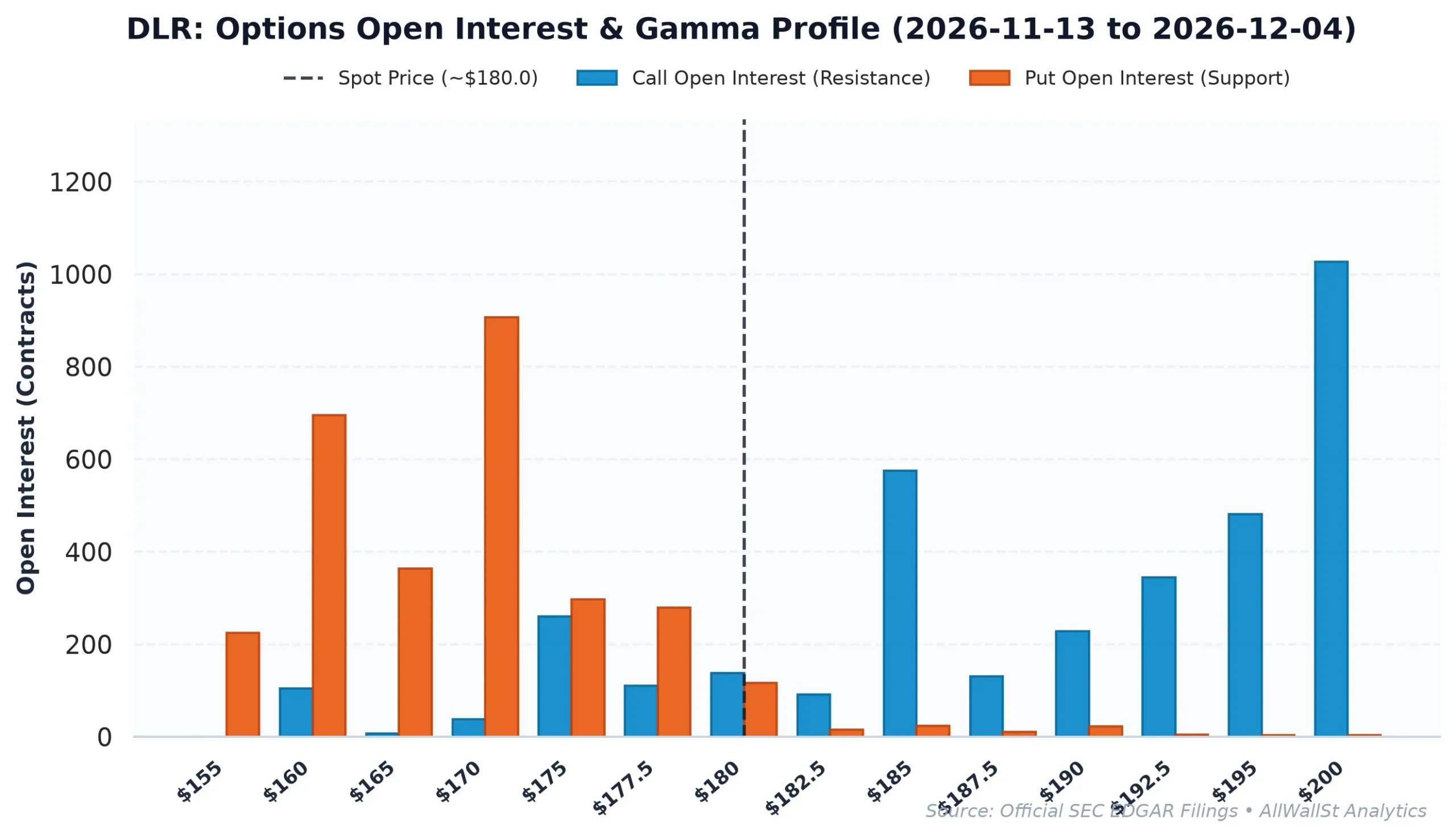
From a market structure perspective, the action in Digital Realty this week was a masterclass in dealer pinning. The options market went into Friday’s expiration with a Max Pain strike of $177.50. With the stock trading at $179.99, it sat just above that magnetic level, held in place by a balanced dealer gamma profile. When gamma is neutral, dealers do not have to aggressively buy or sell the underlying stock to hedge their positions, which often leads to the kind of sideways price action we witnessed today.
The Put/Call Open Interest ratio stands at a nearly perfect 1.05, suggesting that institutional hedging and speculative call buying are in a state of equilibrium. There is a formidable Call Wall at $200, which will likely act as a ceiling for any momentum-driven rallies in the near term. Conversely, the Put Wall at $170 provides a structural floor where dealers would be forced to buy the stock to maintain delta neutrality if a sell-off were to occur.
Looking forward, the 30-day expected move is +/- 13.47 percent, or roughly $24.24. This implies that while the stock is currently pinned, the volatility surface is bracing for a potential breakout or breakdown. Given that the stock is trading at a significant premium to its historical multiples and its peers, the risk is skewed toward a valuation reset if the 10-Year Treasury yield continues to climb toward the 5.5 percent mark.
The fundamental story of Digital Realty is one of operational excellence meeting a difficult macro environment. The company is doing exactly what it should: growing revenue, managing its cash flow, and paying its dividends. But the stock price has already priced in much of that success. For now, the market seems content to let the stock oscillate between its technical walls, waiting for a clearer signal on the direction of interest rates.
Investment Committee Steelman Dissent: The bullish case hinges on the accelerating demand for AI-specific data center capacity, which could lead to a significant upward revision in lease pricing and ROIC as older, lower-priced contracts expire. If the Federal Reserve initiates a surprise easing cycle in early 2027, Digital Realty’s heavy leverage would transform from a headwind into a massive tailwind for equity valuation.
AllWallSt Investment Verdict: HOLD (Initiation)
Digital Realty Trust, Inc. (DLR)
Trailing P/E
Marcus Wolfe Screen
Leverage Profile
30D Channel
Dealer Gamma Pinning & Max Pain Alignment (DLR)
🎯 Max Pain: $177.50
Spot $179.99
Ceiling $200C Resistance ▲
Pristine cash flow conversion (1.84x) and healthy accrual ratio (-2.23%). Zero accounting anomalies detected (LOW ANOMALY RISK).
Elevated Leverage (5.95x Net Debt/EBITDA); balance sheet requires structural deleveraging.
Favorable equity risk premium (+0.52% FCF yield spread over 5.15% US 10-Yr Treasury benchmark).
Max Pain: $177.50 (-1.38%) | P/C Ratio: 1.05 | 30D Channel: $155.75 – $204.23. Dealer gamma bounded between $170 Put Wall and $200 Call Wall.
DLR carries standard index weighting (< 0.6% SPY footprint); sell-side consensus reflects standard earnings momentum rather than index-tracking mandates.
Accumulation Deferred (Await Pullback toward $166.60 – $173.40 Support Pinning)
Sustained weekly close below $170.00 (Put Wall) or acceleration in margin compression.
IC Counter-Thesis: While our neutral stance balances 75.9x trailing earnings and 5.67% FCF yield against a 5.15% 10-year yield hurdle (5.95x Net Debt/EBITDA), a decisive breakout above $200 on accelerating earnings revisions could leave sidelined capital underexposed. Conversely, a breach of $170 would confirm that valuation support is illusory.
Sources & References
- Official SEC Form 10-K Annual Report (Filed 2026-02-13)
- Digital Realty Trust, Inc. Investor Relations
- SEC EDGAR: Digital Realty Trust, Inc. (CIK 0001297996)
- SEC Form 10-Q (Filed Oct 30, 2026)
- SEC Form 8-K (Filed Oct 29, 2026)
Regulatory Disclaimer: This report is for informational purposes only and does not constitute investment advice, financial guidance, or a recommendation to buy or sell any security. AllWallSt research is based on publicly available data and primary regulatory filings. Investing in REITs involves significant risks, including interest rate sensitivity and real estate market fluctuations. Past performance is not indicative of future results. AllWallSt and its contributors may hold positions in the securities discussed. Consult with a certified financial advisor before making any investment decisions.