
If you spent Thursday morning scanning the terminal for news on American Express Company (AXP), you might have been surprised to learn about the progress of a mechanical garage and ventilation installations at the Perron Gold Project. This is a classic bit of market slapstick: a mining company sharing a name with a global financial titan. While the mining firm is busy with power lines, the actual American Express is busy extracting a different kind of ore: merchant discount fees and annual membership dues from a consumer base that seems remarkably indifferent to a 5.07 percent risk free rate.
The institutional reality of American Express is that it remains the most successful hybrid in finance. It is a bank that spends a lot of time pretending it is a luxury lifestyle club. In its recent Form 8-K filing, management repeatedly pointed to the Membership Model as the primary driver of a record $20.1 billion in third quarter revenue. When a bank calls its customers members, it is usually a sign that they have figured out how to charge people for the privilege of borrowing money, which is a neat trick if you can pull it off.
The numbers suggest they are pulling it off with significant velocity. Earnings per share rose 31 percent to $5.42 in the third quarter, or 13 percent on an adjusted basis. This performance allowed the board to raise full year guidance, a move that signals a high degree of confidence in the face of what the rest of the sector calls credit normalization. While regional lenders are sweating over commercial real estate, American Express is busy processing $454 billion in billed business.
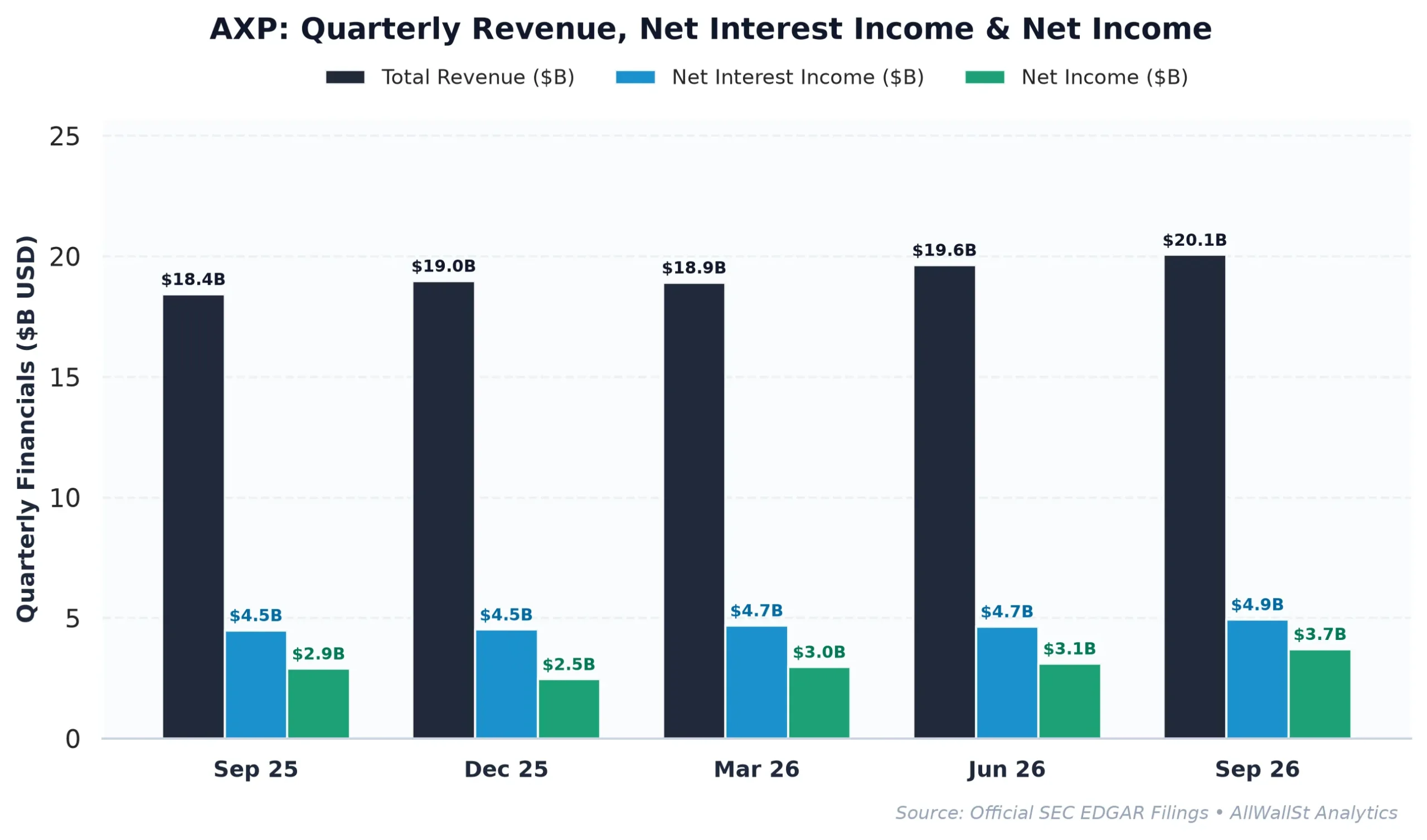
The ROE Engine and the Closed Loop Advantage
To understand why American Express trades at a premium to traditional banks but a discount to pure payment processors, you have to look at the plumbing. Most credit cards involve a four party system: the merchant, the merchant’s bank, the cardholder, and the cardholder’s bank (the issuer). Visa and Mastercard sit in the middle as the network, taking a tiny slice of the transaction without ever actually touching the credit risk. They are tollbooths.
American Express is a closed loop. It is the network and the issuer. When you swipe a Platinum card, American Express is the one lending you the money and the one charging the merchant the fee. This allows them to capture the entire economics of the transaction. The result is a Return on Equity (ROE) of 35.93 percent, a figure that would make a traditional commercial banker weep. For context, ROE measures how much profit a company generates with the money shareholders have invested. Most banks struggle to hit 15 percent in this environment.
The efficiency of this model shows up in the historical trajectory of their net interest income. In FY2022, that figure sat at $9.89 billion. By FY2025, it had climbed to $17.36 billion. This growth has not come at the expense of the balance sheet. The company is a disciplined buyer of its own story, deploying $5.81 billion in annual share repurchases. This creates a total shareholder yield of 3.95 percent, which provides a structural floor for the stock price even when the macro mood sours.
The Tollbooth Discount and Peer Realities
Despite the record revenue and the massive ROE, American Express trades at a forward price to earnings (P/E) multiple of 15.6x. If you look at the peer table below, you will notice a glaring valuation gap between the closed loop model and the pure networks. Visa and Mastercard trade at 24.2x and 27.8x forward earnings, respectively.
| Company (Ticker) | Market Cap | Forward P/E | P/B | ROE | Rev Growth (YoY) | Dividend Yield |
|---|---|---|---|---|---|---|
| American Express (AXP) | $211.5B | 15.6x | 5.91x | 35.93% | 11.30% | 1.20% |
| Visa (V) | $774.7B | 24.2x | 21.66x | 63.51% | 13.2% | 0.75% |
| Mastercard (MA) | $560.5B | 27.8x | 83.09x | 231.37% | 14.0% | 0.54% |
| Capital One Financial (COF) | $110.9B | 7.7x | 1.05x | 9.39% | 6.2% | 1.74% |
The market applies this discount because American Express takes credit risk. If the economy hits a wall, Visa still gets its toll, but American Express has to worry about whether its members can pay back their Balenciaga installments. However, comparing AXP to a pure lender like Capital One (COF), which trades at a meager 7.7x forward earnings and nearly 1.0x book value, reveals the strength of the Amex brand.
Capital One is a bank that has to fight for every deposit. American Express is a brand that people pay $695 a year just to carry in their wallets. This fee income acts as a high margin cushion that traditional banks simply do not have. When you combine that with a net profit margin of 16.82 percent, the 15.6x multiple starts to look like a bargain for an asset that behaves more like a luxury consumer staple than a cyclical financial.
Gamma Walls and the $320 Magnet
While the fundamentals look like a steady compounder, the options market is signaling a bit of a speculative fever. The Put/Call open interest ratio is a lowly 0.47, meaning there are more than two call options for every one put option. In plain English, the “crowd” is heavily betting on more upside. This often creates a situation where options dealers are long the stock to hedge those calls, which can lead to a sharp air pocket if the price stops moving up and those calls start to decay.
The structural anchor for the next few weeks is the Max Pain strike at $320.00. Max Pain is the price point where the most options (both puts and calls) would expire worthless, causing the least amount of payout for market makers. In a market where dealers are the primary liquidity providers, the stock price has a mathematical tendency to be pulled toward this level like a magnet as expiration approaches. With the stock currently trading near $315.40, a move toward that $320 level would represent a modest 1.46 percent gain.
There is also a formidable Call Wall at $345, where over 15,000 contracts are sitting. This acts as a ceiling because dealers who sold those calls have to sell the stock as the price approaches that strike to stay neutral. Conversely, the Put Wall at $310 provides a structural floor. If the stock dips, dealers will be forced to buy the underlying shares to hedge their positions, providing a mechanical bid. For the institutional investor, this means the stock is likely to remain pinned in a range while the business continues to churn out record net income.
Even with the occasional legal nuisance, such as the Venitsky v. American Express National Bank docket in New Jersey, the corporate governance remains tight. There are no sudden C-suite departures to decode, and the 10-D filings for the credit account master trust show delinquency rates that remain well within historical norms. American Express is currently a machine that turns high end consumption into shareholder yield, and as long as the “Membership Model” continues to resonate with the top decile of earners, the valuation gap between AXP and its tollbooth peers remains a primary opportunity.
Investment Committee Steelman Dissent: The primary risk to this thesis is a rapid deterioration in the premium consumer segment, where a spike in credit provisions could wipe out the benefit of record revenue. Furthermore, if the 10-Year Treasury yield remains above 5 percent, the opportunity cost of holding a stock at 6x book value may lead to a broad sector de-rating regardless of individual performance.
AllWallSt Investment Verdict: BUY
American Express Company (AXP)
Investigative Reporting & Public Record Sourcing: Dispatches published under Word on Wall St constitute financial news reporting, investigative journalism, and market commentary on matters of public and economic interest. Information is synthesized from publicly available regulatory filings (including SEC Form 8-K, Form 10-K, and Form 10-Q disclosures), official corporate press communications, verified news reports, and discussions with institutional market participants.
Presumption of Innocence & Unadjudicated Allegations: Any references to executive conduct, personal relationships, workplace misconduct, whistleblower claims, espionage inquiries, internal governance reviews, or government investigations represent reported allegations and active inquiries as of the publication date. They do not constitute formal judicial determinations, legal verdicts, or findings of guilt, civil liability, or statutory wrongdoing unless expressly identified as adjudicated final court judgments.
Protected Editorial Commentary & Non-Investment Counsel: All quantitative scenario analyses, key-person risk haircuts, forward valuation estimates, dealer gamma pinning levels, and investment conviction ratings reflect protected analytical opinion, editorial commentary, and financial modeling under the First Amendment. Nothing herein constitutes legal counsel, personal tax advice, or individualized investment advice. AllWallSt and its contributors assume no liability for trading, investment, or commercial decisions taken on the basis of this report.
Sources & References
- Official SEC Form 10-K Annual Report (Filed 2026-02-06)
- Official SEC Form 10-Q Quarterly Report (Filed 2026-10-23)
- SEC Form 8-K Primary Filing Body (2026-11-16)
- SEC SCHEDULE 13D/A Beneficial Ownership Disclosure (2026-10-01)
- SEC DEF 14A Proxy / M&A Filing (2026-03-25)
- Federal Register (2026-09-10): Fee Rate for Using a Priority Review Voucher in Fiscal Year 2027
- Federal Register (2026-07-30): Food Safety Modernization Act Voluntary Qualified Importer Program User Fee Rate for…
- American Express SEC EDGAR Filings
- American Express Investor Relations
- SEC Form 8-K (Q3 2026 Earnings)
- Federal Court Docket: Venitsky v. American Express National Bank
Regulatory Disclaimer: This report is for informational purposes only and does not constitute investment, legal, or tax advice. AllWallSt is a financial journalism outlet and is not a registered investment advisor. Investing in equities involves significant risk. Past performance is not indicative of future results. The 10-Year Treasury yield and other macro benchmarks are subject to market volatility. Standardized verdicts are based on quantitative desk models and should be evaluated alongside your own financial objectives.