
The 72x Revenue Multiple in a 5.3% World: Inside Palantir’s Valuation Dislocation
If you spend enough time around modern finance textbooks, you learn that interest rates are the universal gravity of asset prices. When the benchmark 10-year US Treasury yield (^TNX) hovers at 5.29%, money is distinctly no longer free. Long-duration sovereign bonds (TLT) sit pinned near multi-year lows at $77.11, and corporate treasurers must actually consider the arithmetic of debt. In theory, when safe government debt pays you more than 5% for doing absolutely nothing, the discount rate applied to distant corporate cash flows rises sharply, and investors demand substantial equity risk premia.
Then there is Palantir Technologies (PLTR), which appears to have negotiated an exemption from gravity.
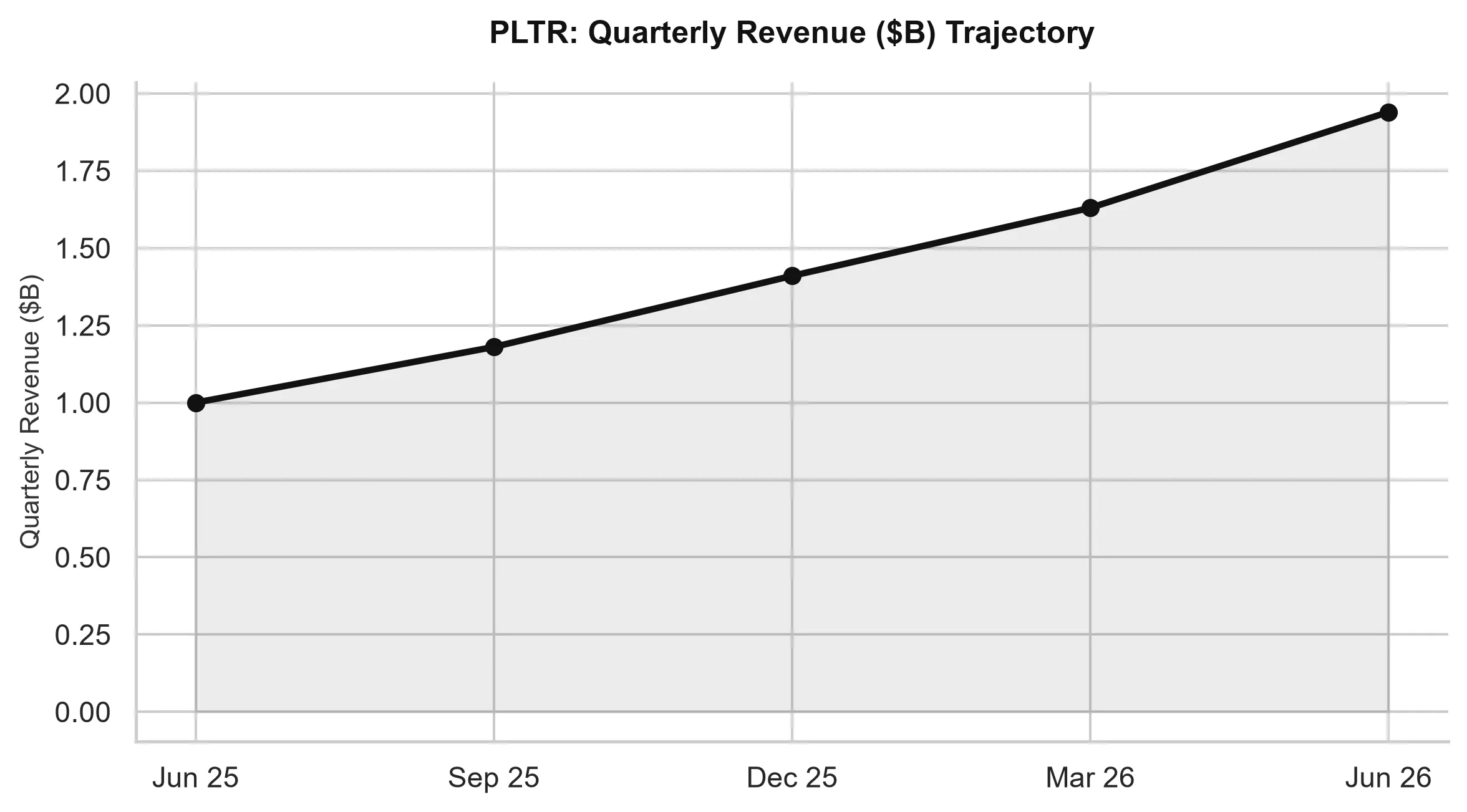
As of this morning, Palantir trades at $193.33 per share, giving the company an equity market capitalization of $464.58 billion and an enterprise value of $446.05 billion. Over the trailing twelve months, Palantir generated $6.16 billion in total revenue and $2.16 billion in free cash flow. If you divide its enterprise value by its revenue, you arrive at a multiple of 72.46x.
To understand how unusual this is, it helps to look at the rest of enterprise software.
Two and a Half Salesforces
Consider Salesforce (CRM), the foundational titan of cloud enterprise software. Salesforce is widely regarded as a mature cash machine. It generated $43.94 billion in revenue over the past four quarters, converting that into $17.73 billion in free cash flow and $9.66 billion in GAAP net income.
The market currently values Salesforce at an enterprise value of $220.09 billion. That works out to 5.01x enterprise value to revenue, 17.06x EV/EBITDA, and a forward price-to-earnings ratio of 14.35x.
Here is the arithmetic:
* Palantir generates $6.16 billion in revenue and is valued at $446.05 billion.
* Salesforce generates $43.94 billion in revenue and is valued at $220.09 billion.
* Palantir generates $2.16 billion in free cash flow.
* Salesforce generates $17.73 billion in free cash flow.
In other words, the public market currently values Palantir at more than double the entire enterprise value of Salesforce, even though Salesforce collects more than seven times as much revenue and produces more than eight times as much cold, liquid cash.
| Metric | Palantir Technologies (PLTR) | Salesforce (CRM) | Dislocation Factor |
|---|---|---|---|
| Market Capitalization | $464.58 Billion | $189.21 Billion | 2.46x higher |
| Enterprise Value (EV) | $446.05 Billion | $220.09 Billion | 2.03x higher |
| Total Revenue (TTM) | $6.16 Billion | $43.94 Billion | 0.14x (7.1x lower) |
| EV / Revenue Multiple | 72.46x | 5.01x | 14.46x premium |
| Trailing P/E Ratio | 166.66x | 21.03x | 7.92x premium |
| Forward P/E Ratio | 82.47x | 14.35x | 5.75x premium |
| Free Cash Flow (TTM) | $2.16 Billion | $17.73 Billion | 0.12x (8.2x lower) |
| Operating Margin | 47.12% | 21.38% | +2,574 bps |
| Total Cash Reserves | $9.41 Billion | $11.40 Billion | Comparable liquid base |
| Total Debt Load | $0.21 Billion | $42.38 Billion | Negligible debt |
If you buy Salesforce at today’s price, you are paying approximately 12.4 times trailing free cash flow. If you buy Palantir, you are paying roughly 206 times trailing free cash flow.
When you pay 72 times revenue and 200 times cash flow for an enterprise software business, you are not merely betting that the company will grow nicely. You are betting that it will become the indispensable operating system for all human economic activity, that no competitor will ever erode its pricing power, and that its margins will expand toward perfection.
The Theology of the Bootcamp
How does a software company command a 72x revenue multiple while sovereign paper yields 5.3%?
Part of the answer is genuine operating momentum. Palantir grew its top-line revenue by 92.80% year-over-year, delivering gross margins of 84.80% and operating margins of 47.12%. Its Artificial Intelligence Platform (AIP) bootcamps have become legendary across corporate America. Instead of standard multi-month software sales cycles involving endless procurement committees, Palantir parachutes engineers into customer offices for three intense days, binds their disparate databases into a unified ontology, and shows executives working prototypes of autonomous workflows.
It is an undeniably brilliant go-to-market strategy. It makes enterprise IT buyers feel like they are purchasing military-grade technology from the future.
Yet the financial mechanics of enterprise software remain governed by balance sheets. A quantitative forensic screen of Palantir’s financial statements surfaces an intriguing working-capital divergence: accounts receivable growth has noticeably outpaced revenue growth over recent reporting periods.
In enterprise software, that divergence often tells a specific story. When software vendors aggressively deploy new flagship platforms, enterprise customers eagerly sign pilot agreements and early production rollouts. But getting corporate procurement to actually release milestone cash payments takes time. Palantir has booked the revenue and expanded customer commitments, but the cash collections trail behind the headline growth print.
The Irony of Parked Cash
There is also a delightful macro irony buried in Palantir’s income statement.
The standard finance critique of high-multiple tech is that rising interest rates destroy valuations by raising the cost of capital. But Palantir carries essentially zero debt ($211.40 million) and sits on a fortress of $9.41 billion in cash and short-term US Treasury bills.
Because benchmark short-term rates remain elevated above 5%, Palantir earns roughly $450 million to $500 million a year in pure interest income simply by leaving its cash parked in Treasury bills. That non-operating interest income flows straight down to GAAP net income, flattering its reported bottom line and helping fuel the retail narrative that the company has turned into an unstoppable profit engine.
So the very interest rate environment that makes a 72x sales multiple analytically precarious is simultaneously padding Palantir’s quarterly net income. It is financial engineering by circumstance: the company is partly funded by the Pentagon, partly funded by commercial enterprises, and significantly subsidized by the US Department of the Treasury.
What Happens When Expectations Meet Gravity
The difficulty with trading at 72 times revenue is not that Palantir is a bad company. Palantir is a formidable, highly profitable business with exceptional software defensibility.
The difficulty is that multiples are expectations, and 72x revenue leaves zero margin for human imperfection. If commercial software spending tightens, if enterprise clients balk at annual license renewals once the initial bootcamp novelty fades, or if hyperscalers like Microsoft and Amazon develop competing ontology layers, the multiple does not need to collapse to 5x like Salesforce to inflict pain. If Palantir’s revenue multiple merely halves to 36x, it would still be one of the most expensive technology companies in modern market history, yet its share price would drop by 50%.
In a market where the 10-year Treasury yield is 5.29%, investors can earn a guaranteed real return without forecasting enterprise software adoption in 2035. Paying 72 times revenue today is a declaration that valuation math has ceased to matter. Historically, that declaration lasts exactly until the next quarterly guidance print.
Sources & References
- Palantir Technologies Investor Relations: Official SEC filings, quarterly earnings transcripts, and AIP platform documentation (investors.palantir.com)
- Salesforce Investor Relations: Form 10-K annual report and quarterly GAAP financial metrics (investor.salesforce.com)
- US Securities and Exchange Commission: SEC EDGAR Form 10-Q and 10-K database filings (sec.gov/edgar)
- Federal Reserve Economic Data (FRED): 10-Year Treasury Constant Maturity Rate and US benchmark yield curve data (fred.stlouisfed.org)
Disclaimer: This analysis is published for institutional financial research and educational purposes only and does not constitute investment advice, financial guidance, or an endorsement of any particular trading strategy. The securities mentioned may fluctuate significantly based on market volatility, macro interest rates, and underlying operational performance.