
The Forty-Four Billion Dollar Security Blanket
When a high-flying software company sees its organic growth trajectory begin to normalize, it faces a fundamental strategic choice. It can accept its transition into a mature corporate enterprise, cut executive equity grants, and optimize for real GAAP profitability. Alternatively, it can buy its primary competitor for $43.9 billion in stock and cash, label the enterprise a transformational consolidation, and promise Wall Street that two money-losing balance sheets will magically yield half a billion dollars in fresh free cash flow.
CrowdStrike Holdings, Inc. (CRWD) chose the empire option. The enterprise announced a definitive $43.9 billion deal to acquire Zscaler, Inc., claiming the combination will create cybersecurity’s definitive operating system with over $10 billion in combined annual recurring revenue. Mainstream commentary spent the morning celebrating the birth of an unstoppable software titan, but equity markets were far less enamored, knocking CrowdStrike shares down 12% to $205.25.
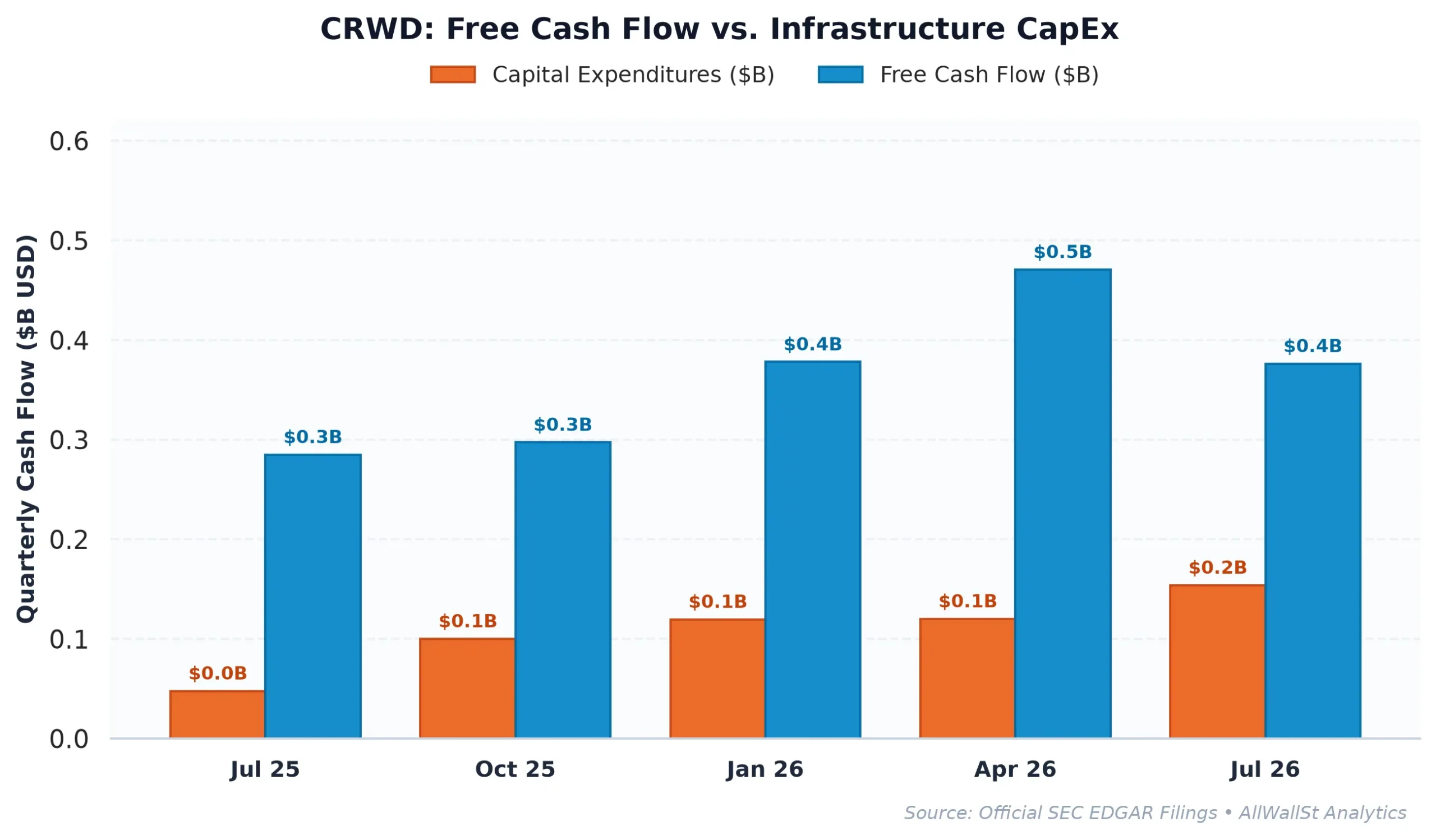
This market reaction validates the concerns we outlined 31 days ago when we initiated coverage on CrowdStrike with a HOLD rating at $257.57. At that time, we cautioned that paying over 100 times forward earnings left zero margin of safety for operational missteps or slowing customer expansion. Today, with the equity down 20% since our prior review, management has effectively admitted that internal growth alone cannot justify its multi-hundred-billion-dollar valuation umbrella.
Accounting Synergies and the Stock Compensation Machine
To understand why paying a massive premium for Zscaler creates structural risk for shareholders, one must look closely at how software cash flows are constructed. In its latest SEC filings, CrowdStrike highlighted $1.24B in free cash flow for FY2026, alongside an impressive Rule of 40 score of 62.8%. On paper, these figures suggest an exceptionally healthy software compounding engine.
The accounting reality tells a sharper story once you account for executive compensation. Over the same FY2026 period, CrowdStrike recorded $1.10B in stock-based compensation, which absorbed 54.4% of its operating cash flow. When you subtract equity dilution from reported cash flows, real economic free cash flow drops to just $0.90 billion, translating into a meager 0.43% real cash yield.
| Period | Revenue | Operating Income | Operating Margin | Free Cash Flow | SBC Expense |
|---|---|---|---|---|---|
| FY2023 | $2.24B | $-190.1M | -8.5% | $674.6M | $526.5M |
| FY2024 | $3.06B | $-19.1M | -0.6% | $929.1M | $648.7M |
| FY2025 | $3.95B | $-116.4M | -2.9% | $1.07B | $861.4M |
| FY2026 | $4.81B | $-293.3M | -6.1% | $1.24B | $1.10B |
The multi-year trajectory reveals expanding GAAP losses despite rapid top-line scaling. CrowdStrike’s operating margin worsened from -0.6% in FY2024 to -6.1% in FY2026 as operating losses reached -$293.3M. Rather than demonstrating operating leverage, the core business model has relied heavily on share creation to fund daily operations. Acquiring another firm with negative GAAP operating margins does not fix these underlying mechanics; it simply expands the size of the share issuing engine.
The Multiple Gap and Empire Expansion
When evaluating megamergers in software, relative valuation spreads dictate whether a transaction creates or destroys equity value. CrowdStrike is issuing premium equity to swallow Zscaler, yet its own multiple remains drastically inflated relative to established cybersecurity peers.
| Company (Ticker) | Market Cap | Forward P/E | EV/EBITDA | Rev Growth (YoY) | Operating Margin | FCF Yield |
|---|---|---|---|---|---|---|
| CrowdStrike Holdings (CRWD) | $210.2B | 127.3x | N/M (>500x) | 25.80% | -2.47% | 0.95% |
| Palo Alto Networks (PANW) | $290.8B | 71.9x | 173.2x | 39.2% | 4.9% | 1.54% |
| Fortinet (FTNT) | $95.8B | 33.4x | 31.7x | 20.5% | 32.9% | 2.60% |
| Zscaler (ZS) | $36.6B | 39.9x | N/M (>500x) | 24.9% | -3.5% | 2.93% |
CrowdStrike trades at 127.3x forward earnings, representing a massive premium over Palo Alto Networks at 71.9x and Fortinet at 33.4x. While Fortinet generates a positive 32.9% operating margin and a 2.60% free cash flow yield, CrowdStrike continues to trade at a sub-1% cash yield while posting negative operating margins.
Zscaler generated an operating margin of -3.5% prior to the deal announcement. Combining two platforms that both generate GAAP operating losses creates significant integration overhead. Merging sales organizations, eliminating redundant cloud architecture, and aligning compensation structures historically takes years, during which enterprise focus shifts inward while competitors win unencumbered accounts.
Market Plumbing, Options Volatility, and the Verdict
Options market positioning reveals how institutional derivatives desks are pricing this corporate event. The Put/Call open interest ratio stands at 0.63, indicating a strong speculative call bias among retail and institutional traders. However, the Max Pain strike (the price level where the maximum number of option contracts expire worthless) sits up at $230.00, representing a 12.1% premium over the current spot price.
Primary call resistance forms a dense ceiling between $255 and $260, where option sellers have built substantial short positions. On the downside, primary put support sits down at $200 and $175. Near-term option market structure shows significant overhead supply, suggesting that any relief rally will likely encounter aggressive selling near resistance walls.
At-the-money implied volatility sits elevated at 71.65%, projecting an expected 30-day price move of +/-$42.13 (or 20.54%). While off-hours bid-ask spreads across options contracts can temporarily inflate implied volatility metrics, the underlying options surface reflects real market anxiety over transaction closing conditions and regulatory review timelines.
Bulls will argue that combining CrowdStrike’s endpoint security with Zscaler’s Zero Trust network access creates an structural platform moat capable of extracting multi-product contract wins across 8,000 shared enterprise clients. If management successfully delivers its $500 million run-rate free cash flow accretion target while preserving 25%+ organic expansion, scale efficiency could eventually support a premium valuation.
However, paying $43.9 billion to acquire growth while real economic free cash flow yields remain below 0.5% leaves common shareholders exposed to severe multiple compression if integration friction delays revenue realization.
AllWallSt Investment Verdict: SELL (Downgrade from HOLD)
CrowdStrike Holdings, Inc. (CRWD)
Sources & References
- Official SEC Form 10-K Annual Report (Filed 2026-03-05)
- Official SEC Form 10-Q Quarterly Report (Filed 2026-08-27)
- SEC Form 8-K Exhibit 99.1 (Press Release / Earnings) (2026-11-23)
- SEC Form 8-K Exhibit 99.1 (Press Release / Earnings) (2026-11-23)
- SEC 425 Proxy / M&A Filing (2026-11-23)
- SEC EDGAR Corporate Filings: CrowdStrike Holdings, Inc. CIK 0001535527
- SEC Form 8-K Current Report (Nov 23, 2026): Definitive Merger Agreement & Financial Results
- Official Investor Relations Portal: CrowdStrike Investor Relations
Disclaimer: This analysis is provided for informational and educational purposes only and does not constitute financial advice or a recommendation to buy or sell securities. All investments carry market risk, including the loss of principal.