
The 156x Revenue Illusion: Inside MicroStrategy’s $60 Billion Perpetual Motion Machine
There are several ways to run a public software company.
The traditional method is to write code, sell enterprise licenses, hire a sales force, generate free cash flow, and occasionally buy back stock or pay a modest dividend.
The second method is to realize that your core enterprise business intelligence software generates roughly $498 million in annual revenue, notice that nobody in Silicon Valley has thought about on-premise relational reporting tools since 2008, and decide instead to turn your entire corporate charter into an offshore-style leveraged hedge fund that buys spot Bitcoin with borrowed money.
This is the path chosen by MicroStrategy Incorporated.
As of Thursday afternoon, MicroStrategy trades at $150.49 per share, giving the company an equity market capitalization of $60.01 billion and an enterprise value of $77.69 billion.
If you examine MicroStrategy through the conventional lens of an enterprise software provider, the financial statement numbers cease to make sense in human terms. Over the trailing twelve months, the company generated $498.35 million in total revenue and reported a GAAP net loss of negative $31.37 billion.
Its operating margin stands at negative 6,808.11%. Its enterprise value to revenue multiple sits at 155.90x. Meanwhile, the company carries $6.77 billion in total long-term debt against $2.45 billion in cash reserves, with debt balances expanding above $8.2 billion in recent quarterly filings.
To call MicroStrategy an enterprise software business is an accounting fiction. MicroStrategy is a leveraged closed-end fund trading at an astronomical premium to the net asset value of the underlying tokens sitting in its custody vault.
Understanding the mechanics of this corporate structure reveals one of the most fascinating reflexivity loops in modern market history, alongside severe structural risks that retail shareholders are largely ignoring.
The Macro Backdrop: The Cost of Refinancing in a 5.2% Yield World
Thursday’s macroeconomic tape highlights the friction facing balance-sheet financial engineering:
- Benchmark Yields: The 10-Year US Treasury yield (^TNX) trades at 5.239%, remaining elevated near cyclical peaks. The cost of corporate debt capital has structurally adjusted higher.
- Energy Spikes: Crude oil proxy (USO) gained 2.95% to $148.16, keeping inflation risks alive across the fixed income horizon.
- Equity Market Softness: The Nasdaq 100 (QQQ) dropped 1.26% to $748.20, and the S&P 500 (SPY) shed 0.50% to $773.37.
- Volatility Creep: The CBOE Volatility Index (^VIX) advanced 4.71% to 15.79.
In a zero-interest-rate environment, issuing zero-coupon or low-coupon convertible debt is virtually free. But as Treasury yields stay locked above 5.2%, institutional credit investors demand higher conversion premiums or explicit coupon payments, increasing the structural cash drag on issuers that lack operational cash flow.
The Core Financial Anatomy: The Deterministic Breakdown
Here are the deterministic baseline figures for MicroStrategy against the broader enterprise software and tech landscape:
| Metric | MicroStrategy (MSTR) | Software Benchmark | Technology Sector (XLK) |
|---|---|---|---|
| Share Price | $150.49 | N/A | $198.17 |
| Market Capitalization | $60.01 Billion | N/A | N/A |
| Enterprise Value | $77.69 Billion | N/A | N/A |
| EV / Revenue Multiple | 155.90x | 8.50x | 7.20x |
| Total Revenue | $498.35 Million | N/A | N/A |
| Operating Margin | -6,808.11% | +18.40% | +24.50% |
| Net Income (TTM) | -$31.37 Billion | Positive | Positive |
| Free Cash Flow | -$22.59 Billion | Positive | Positive |
| Total Debt | $6.77 Billion | Modest | Minimal Net Debt |
| Total Cash | $2.45 Billion | Strong | Substantial |
| Return on Equity (ROE) | -63.56% | +14.20% | +29.40% |
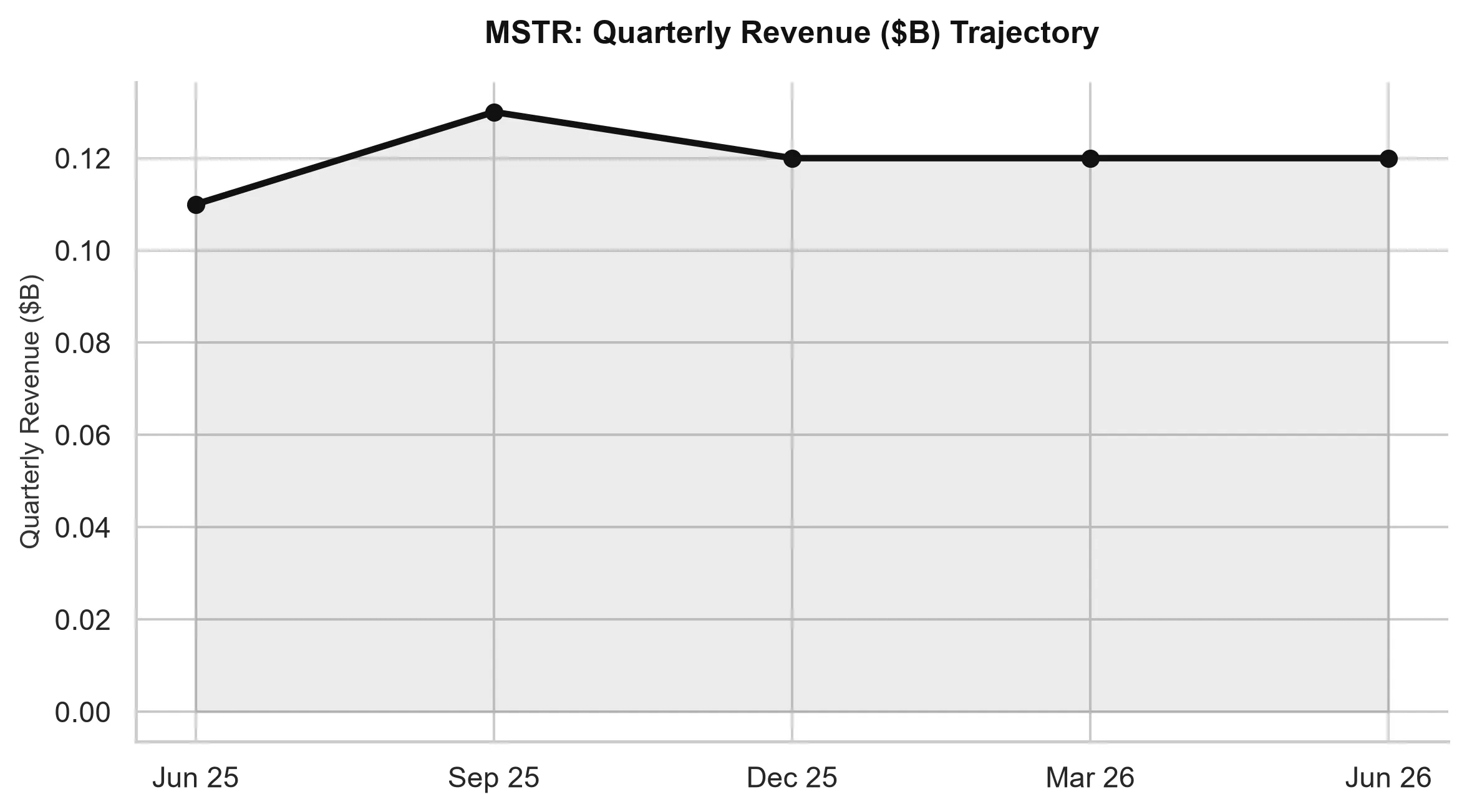
The core software business grew revenue by just 6.90% year-over-year, generating less than $500 million. In software circles, a business of this scale with flat secular growth would typically trade between 3x and 6x sales, implying an enterprise value for the software operations of roughly $1.5 billion to $3.0 billion.
The remaining $75 billion of enterprise value represents the market value of its digital asset treasury holdings, combined with a speculative premium paid by equity investors who want leveraged exposure to the underlying asset.
The Perpetual Motion Machine: How the Loop Works
How does a company with negative $22.59 billion in free cash flow and a negative 6,808% operating margin continue to expand its balance sheet?
The mechanism relies on a reflexive loop:
1. The NAV Premium Arbitrage
Investors who cannot or will not buy Bitcoin directly in spot markets, including certain restricted institutional funds and retirement accounts, purchase MicroStrategy shares. This demand bids the stock up until its market cap trades at a significant premium to the net asset value (NAV) of the Bitcoin it owns.
2. At-The-Market (ATM) Equity Offerings
When your stock trades at a 1.5x or 2.0x premium to your assets, you possess a legal printing press. You sell newly issued common shares into the open market at $1.50 or $2.00 of equity value per $1.00 of underlying assets. You then take the cash proceeds and purchase $1.00 worth of Bitcoin.
Because you sold overvalued stock to purchase hard assets, the transaction is accretive to Bitcoin-per-share metrics. Management celebrates this as “Bitcoin Yield.”
3. Convertible Debt Issuance
Next, you issue billions of dollars in convertible senior notes. Convertible hedge funds buy the debt not because they believe in enterprise business intelligence, but because they can execute a classic convertible arbitrage trade: they buy the bond, collect the yield or optionality, and short the underlying equity to delta-hedge their position.
MicroStrategy takes the borrowed cash from the convertible bond offering and buys more Bitcoin. This purchase creates upward price momentum in the token, which drives up MicroStrategy’s stock price, expanding the NAV premium, which allows the company to issue even more convertible debt and ATM equity.
It is a perpetual motion machine of financial engineering. As long as the NAV premium remains positive and token prices rise, the flywheel accelerates.
Forensic Risk Audit: The Reflexivity Trap
Every perpetual motion machine in Wall Street history has a vulnerability. In MicroStrategy’s case, that vulnerability is reflexivity operating in reverse.
1. The Disappearing NAV Premium
Closed-end funds that hold liquid assets almost always trade at a discount to NAV over long time horizons, not a premium.
Now that regulated spot ETFs exist in the United States, charging management fees as low as 0.20%, institutional capital has zero structural need to pay an elevated premium for indirect exposure through a corporate intermediary. If MicroStrategy’s NAV multiple compresses from a premium toward parity, or worse, flips to a traditional closed-end fund discount, the accretion flywheel shatters immediately.
Selling equity at or below NAV to buy assets is instantly dilutive to existing shareholders.
2. The Debt Maturity Wall
MicroStrategy carries over $6.77 billion in principal debt obligations, with total debt expanding past $8.2 billion.
When convertible notes mature, issuers hope the stock price has risen well above the conversion strike price so bondholders elect to convert into shares. If the stock trades below the conversion price at maturity, bondholders demand full cash repayment of the principal.
Because the underlying software business generates negligible free cash flow, negative $22.59 billion on an all-in basis, MicroStrategy cannot service or repay multi-billion dollar debt maturities out of software earnings. It would be forced to either:
* Issue massive amounts of highly dilutive equity at distressed prices.
* Issue new high-yield debt in a 5.2% interest rate regime.
* Sell underlying treasury assets, turning from the market’s largest programmatic buyer into its largest forced seller.
3. The Convertible Arbitrage Overhang
Convertible arbitrage desks that hold MicroStrategy debt dynamically short the common stock as volatility rises. If the stock drops sharply, dealer delta-hedging models mandate increased short selling, creating mechanical selling pressure that accelerates downward price cascades.
📊 AllWallSt Investment Verdict
| Company / Ticker | Rating | Word/Horizon |
|---|---|---|
| MicroStrategy Incorporated (MSTR) | SELL / HIGH RISK | 12 to 18 Months |
Conviction rating derived deterministically from Layer 3 metrics, options flow, and fundamental review.
The Strategic Verdict
Financial engineering can manufacture optical earnings, synthetic yields, and remarkable momentum during expansion phases. But financial engineering cannot alter the fundamental laws of arithmetic.
MicroStrategy has built a $60 billion valuation on top of a $500 million software foundation that carries an operating margin of negative 6,808%. Equity holders are paying a massive valuation premium to own borrowed assets that could be purchased directly at spot prices without debt leverage or corporate overhead.
In an economic climate where Treasury yields stay firm at 5.2% and financial conditions tighten, paying 156 times sales for an offshore-style treasury arbitrage vehicle represents extreme risk asymmetry. When the flywheel slows, arithmetic always wins.
Sources & References
- Regulatory Filings: U.S. Securities and Exchange Commission EDGAR – MicroStrategy Inc. (CIK 0001050446)
- Corporate Disclosures: MicroStrategy Investor Relations Portal
- Market Benchmarks & Rates: U.S. Department of the Treasury (Daily Treasury Par Yield Curve Rates) and Chicago Board Options Exchange (CBOE).
- Deterministic Calculations: Metrics calculated deterministically via Python execution scripts from official SEC Form 10-K and 10-Q corporate disclosures.
Disclaimer: This forensic research report is compiled for institutional research and educational purposes only and does not constitute financial, investment, legal, or tax advice. The securities analyzed carry substantial capital risk, volatility, and leverage. Conduct independent research and consult licensed financial advisors before making investment decisions.