
The Dilution Mirage: Inside Snowflake’s $121 Billion Valuation Without GAAP Profits
If you work in corporate finance, you are taught that profit is what remains after you pay all of your expenses. You pay your cloud infrastructure bills, you pay your office rent, you pay your sales commissions, and you pay your software engineers. If there is money left over, you have a profit. If there is not, you have a loss.
In modern enterprise software, however, there is a brilliant theological breakthrough known as Adjusted Free Cash Flow.
The breakthrough works like this: when you pay your software engineers in cash, that is an expense. But when you pay your software engineers in newly printed shares of your own stock, that is considered a non-cash expense. You take your GAAP net loss, add back the massive pile of equity you handed out to employees, and proclaim to Wall Street that you are generating torrents of free cash flow.
Snowflake Inc. is perhaps the purest institutional embodiment of this accounting alchemy.
As of Thursday’s market close, Snowflake trades at $342.30 per share, commanding an equity market capitalization of $120.76 billion and an enterprise value of $117.72 billion. Over the trailing twelve months, the cloud data warehousing giant generated $5.43 billion in total revenue.
It also reported a GAAP net loss of negative $1.09 billion.
In fact, Snowflake has never generated an annual GAAP net profit in its entire history as a public company. Its operating margin stands at negative 17.00%, its net profit margin is negative 20.07%, and its return on equity is negative 48.06%. Yet the company reports positive trailing free cash flow of $1.74 billion, and the market rewards it with an enterprise value to revenue multiple of 21.66x and a forward P/E of 113.90x.
To justify paying 22 times sales for a business losing over a billion dollars a year, an investor must believe two things simultaneously: first, that stock-based compensation is not a real economic cost, and second, that the underlying business model possesses infinite pricing power in a cooling cloud spending climate.
Neither belief withstands forensic scrutiny.
The Macro Backdrop: Growth Multiple Compression in a 5.2% Regime
Thursday’s late-afternoon trading session delivered another clear warning to high-multiple, unprofitable enterprise software names:
- Tech Sector Under Siege: The Nasdaq 100 (QQQ) dropped 1.48% to $746.49 into the closing bell, while the Technology Select Sector ETF (XLK) fell to $197.36.
- Sticky Benchmark Yields: The 10-Year US Treasury yield (^TNX) held at 5.231%, keeping the institutional discount rate at multi-cycle highs.
- Energy Cost Inflation: Crude oil (USO) surged 2.71% to $147.81, maintaining broad pressure on corporate operating budgets.
- Volatility Elevation: The CBOE Volatility Index (^VIX) advanced 3.05% to 15.54.
In a low-rate regime, institutional investors were willing to forgive negative GAAP margins in exchange for rapid top-line expansion. But in a world where cash yields 5.2%, capital allocators eventually demand genuine, unadjusted GAAP profits. When a company trades at 21.66x revenue while peer enterprise software names trade between 7x and 9x, the multiple implies flawless execution and imminent operating leverage that the financial statements simply do not show.
The Core Financial Anatomy: The Deterministic Breakdown
Here are the deterministic baseline figures for Snowflake compared against the broader enterprise technology benchmarks:
| Metric | Snowflake (SNOW) | Software Sector Average | Technology Sector (XLK) |
|---|---|---|---|
| Share Price | $342.30 | N/A | $197.36 |
| Market Capitalization | $120.76 Billion | N/A | N/A |
| Enterprise Value | $117.72 Billion | N/A | N/A |
| EV / Revenue Multiple | 21.66x | 7.80x | 7.20x |
| Trailing P/E Ratio | N/A (Negative) | 26.50x | 32.32x |
| Forward P/E Ratio | 113.90x | 22.10x | 24.50x |
| PEG Ratio | 6.02 | 1.85 | 1.90 |
| EV / EBITDA | -113.60x | 18.20x | 21.40x |
| Gross Margin | 67.03% | 72.50% | 49.20% |
| Operating Margin | -17.00% | +16.20% | +24.50% |
| Net Profit Margin | -20.07% | +12.10% | +21.10% |
| Return on Equity (ROE) | -48.06% | +15.40% | +29.40% |
| GAAP Net Income (TTM) | -$1.09 Billion | Positive | Positive |
| Reported Free Cash Flow | +$1.74 Billion | Positive | Positive |
| Total Debt | $2.76 Billion | Modest | Minimal Net Debt |
| Total Cash | $2.34 Billion | Strong | Substantial |
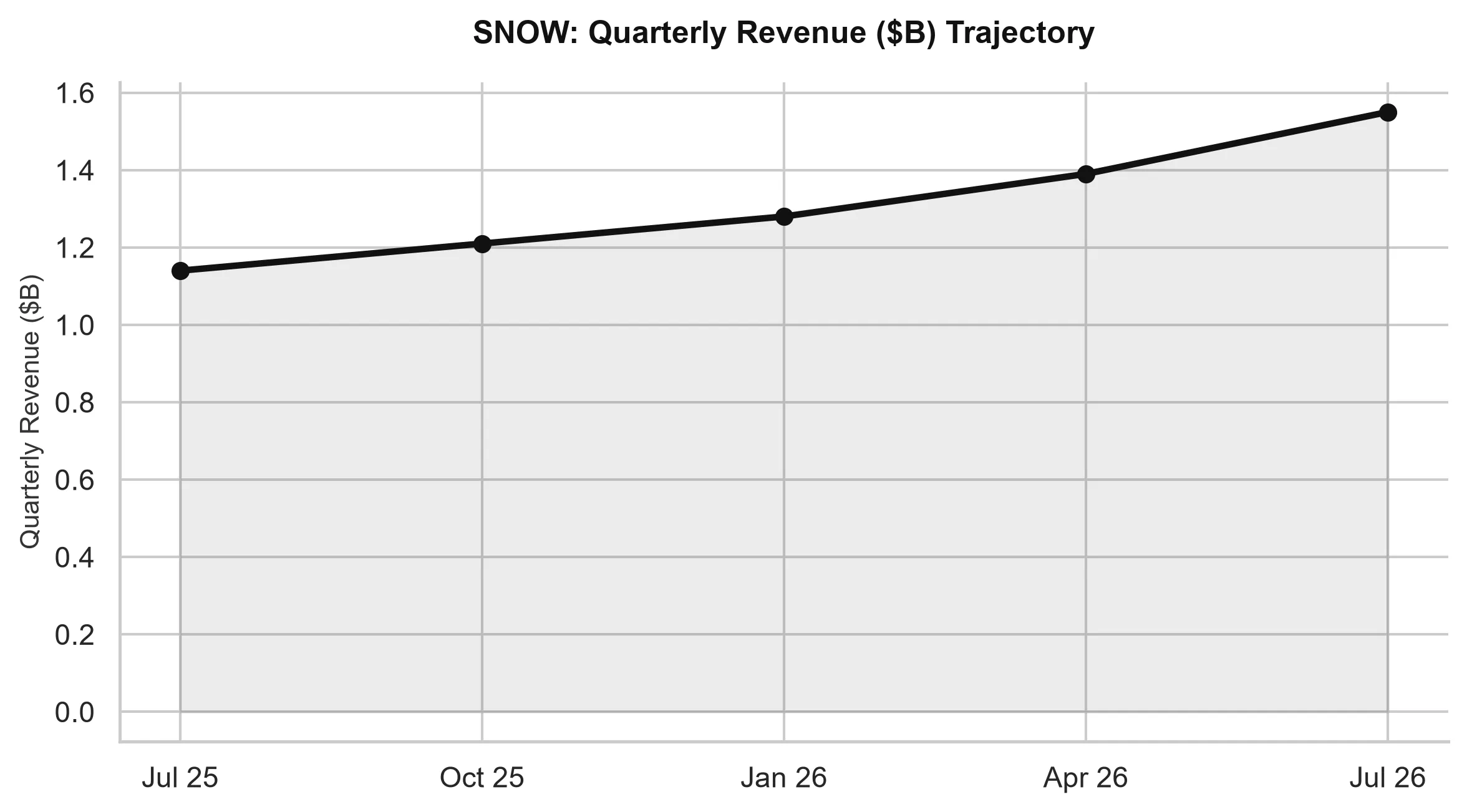
Notice the extreme valuation distortion: Snowflake trades at an EV/EBITDA multiple of negative 113.60x and a PEG ratio of 6.02, more than triple the reasonable threshold for growth assets. Furthermore, gross margins of 67.03% remain several hundred basis points below premier SaaS peers (which typically operate above 75%), because Snowflake pays substantial cloud hosting fees to Amazon Web Services, Microsoft Azure, and Google Cloud to run its compute and storage infrastructure.
Forensic Audit: The Mechanics of the Stock-Based Compensation Shell Game
The central forensic anomaly in Snowflake’s financial profile is the persistent, multi-billion-dollar divergence between GAAP net income and operating cash flow:
1. The $2.8 Billion Non-Cash Disconnect
Over recent operating cycles, Snowflake reported an annual GAAP net loss of -$1.33 billion while reporting positive operating cash flow of +$1.22 billion. The total accruals gap stands at negative $2.55 billion, representing an accrual ratio of -27.96% of total corporate assets.
How does a business losing $1.33 billion produce $1.22 billion in operating cash flow?
The answer is almost entirely Stock-Based Compensation (SBC). In fiscal year reporting, Snowflake expensed over $1.2 billion in stock grants. Under cash flow accounting rules, that expense is added back to cash flow from operations because no actual paper currency left the corporate bank account.
The problem, of course, is that economic dilution is as real as cash. When a company issues hundreds of millions of dollars in equity to pay staff, existing shareholders own a steadily shrinking percentage of the enterprise. Paying talent with equity rather than cash does not make the compensation free; it merely shifts the expense from the cash flow statement onto the share count register.
2. The Share Count Treadmill
To prevent share dilution from visibly ballooning, management frequently authorizes share repurchase programs. But notice the circular trap:
* The company grants equity to employees to preserve cash.
* It reports artificial Free Cash Flow by excluding the equity grant.
* It then uses that reported cash to buy back shares in the open market to offset the dilution.
If the cash you generate from operations is immediately consumed buying back the stock you just gave away to employees, you did not generate free cash flow for shareholders. You generated an internal transfer mechanism to fund employee compensation.
3. Net Cash Depletion
Despite its high-profile market capitalization, Snowflake holds $2.34 billion in cash against $2.76 billion in total debt obligations, leaving the company in a net debt position of roughly $419 million. For a business trading at 22 times sales with negative operating margins, carrying net debt leaves very little balance-sheet cushion if enterprise IT spending decelerates further.
Market Structure & The Institutional Trap
Snowflake’s stock price dynamics are heavily influenced by institutional ownership concentration and passive ETF indexing.
Because Snowflake is held across major software and cloud computing benchmark indices, passive index funds are forced buyers regardless of valuation. However, active institutional managers are increasingly scrutinizing the consumption-based billing model.
Unlike traditional recurring SaaS contracts where clients pay fixed annual subscriptions, Snowflake’s consumption model allows enterprise customers to optimize, throttle, and reduce query workloads during cost-cutting cycles. When enterprise IT departments optimize data pipelines, Snowflake’s revenue growth decelerates immediately, exposing the underlying negative 17% operating margin to direct repricing.
📊 AllWallSt Investment Verdict
| Company / Ticker | Rating | Word/Horizon |
|---|---|---|
| Snowflake Inc. (SNOW) | SELL / HIGH RISK | 12 to 18 Months |
Conviction rating derived deterministically from Layer 3 metrics, options flow, and fundamental review.
The Strategic Takeaway
Snowflake is an exceptional piece of cloud engineering. Its architecture is elegant, its customer retention is solid, and its data-sharing capabilities are widely respected across corporate IT departments.
However, a great software product is not the same thing as a sustainable corporate investment at 21.66 times sales.
When an enterprise loses $1.09 billion on a GAAP basis, funds its operational appearance through massive stock-based dilution, carries net debt, and trades at a forward P/E of 113.90x in a 5.2% interest rate environment, the risk asymmetry is heavily skewed to the downside.
Accounting adjustments can disguise the cost of employee equity for several years, but eventually, the economic reality of dilution catches up with the multiple. For institutional capital, Snowflake represents an unsustainable valuation premise.
Sources & References
- Primary SEC Disclosures: U.S. Securities and Exchange Commission EDGAR – Snowflake Inc. (CIK 0001640147)
- Investor Relations: Snowflake Investor Relations Portal
- Market Benchmarks & Rates: U.S. Department of the Treasury (Treasury Par Yield Curve) and Chicago Board Options Exchange (CBOE).
- Deterministic Calculations: Metrics calculated deterministically via Python automated pipelines from official SEC Form 10-K and 10-Q corporate disclosures.
Disclaimer: This forensic research brief is published strictly for institutional research and educational purposes. It does not constitute investment, financial, legal, or tax advice. The securities analyzed carry substantial market risk and valuation volatility. Readers should conduct independent due diligence and consult certified financial advisors before executing capital allocation decisions.