
The Megawatt Arbitrage: Inside IREN’s $17 Billion AI Pivot and $4 Billion Cash Burn
If you are an investor looking for a clean, structural theme in 2026, the artificial intelligence energy bottleneck is about as clean as it gets.
Everyone agrees on the premise: building frontier large language models requires tens of thousands of power-hungry graphics processors, modern GPUs require gigawatts of electricity, and the regulated electrical utility queue to interconnect a new 500-megawatt substation takes anywhere from four to seven years. If you own a substation, you hold the keys to the future.
If you are a Bitcoin mining company that owns substations in Texas and British Columbia, you realize something even better.
You realize that Wall Street currently values Bitcoin mining companies at roughly two to four times revenue, because mining cryptocurrencies is a cyclical, commoditized bloodsport where your computational hardware becomes obsolete every four years. But Wall Street values AI data center infrastructure at twenty to thirty times revenue.
So what do you do? You rebrand. You change your name from Iris Energy to IREN Ltd, order several thousand Nvidia processors, issue press releases about high-performance computing, and watch the market re-rate your equity from a struggling crypto hash-rate operator into an indispensable artificial intelligence infrastructure darling.
It is a wonderful corporate transformation. But once you look past the investor presentation slides, the underlying financial arithmetic tells a far more complicated story.
The Macro Environment: Power Constraints and the 5.2% Cost of Capital
Thursday afternoon’s cross-asset macro close provides the essential context for capital-intensive infrastructure plays:
- Late-Day Tech Retracement: The Nasdaq 100 (QQQ) dropped 1.37% to $747.38, while the S&P 500 (SPY) retreated 0.45% to $773.70.
- Firm Sovereign Yields: The 10-Year US Treasury yield (^TNX) trades at 5.231%, meaning debt financing remains structurally expensive across institutional bond markets.
- Commodity Cost Pressure: Crude oil (USO) gained 2.55% to $147.58, reinforcing the inflationary backdrop for energy and industrial materials.
- Elevated Options Volatility: The CBOE Volatility Index (^VIX) advanced 3.12% to 15.55.
Building multi-hundred-megawatt data centers requires enormous quantities of upfront capital: concrete, chillers, backup diesel generators, liquid-cooling distribution units, and high-voltage switchgear. In a zero-interest-rate world, borrowing billions of dollars to speculate on speculative compute buildouts is cheap. At a 5.2% risk-free rate, every dollar of debt capital carries a heavy annual toll.
The Core Fundamentals: The Deterministic Breakdown
As of Thursday, IREN trades at $35.73 per share, giving the company an equity market capitalization of $14.08 billion and an enterprise value of $17.19 billion.
Here are the deterministic baseline figures extracted from official regulatory filings:
| Metric | IREN Ltd (IREN) | Energy Sector (XLE) | Technology Sector (XLK) |
|---|---|---|---|
| Share Price | $35.73 | $65.22 | $197.76 |
| Market Capitalization | $14.08 Billion | N/A | N/A |
| Enterprise Value | $17.19 Billion | N/A | N/A |
| EV / Revenue Multiple | 24.31x | 1.80x | 7.20x |
| EV / EBITDA Multiple | 448.28x | 6.80x | 21.40x |
| Gross Margin | 68.92% | 38.20% | 49.20% |
| Operating Margin | -102.47% | +18.40% | +24.50% |
| Net Profit Margin | -99.38% | +14.20% | +21.10% |
| Return on Equity (ROE) | -23.41% | +16.80% | +29.40% |
| YoY Revenue Growth | -26.70% | +4.10% | +12.40% |
| Total Revenue | $707.01 Million | N/A | N/A |
| GAAP Net Income | -$702.62 Million | N/A | N/A |
| Free Cash Flow | -$4.22 Billion | Strongly Positive | Strongly Positive |
| Total Cash | $5.90 Billion | Strong | Substantial |
| Total Debt | $7.84 Billion | Modest | Minimal Net Debt |
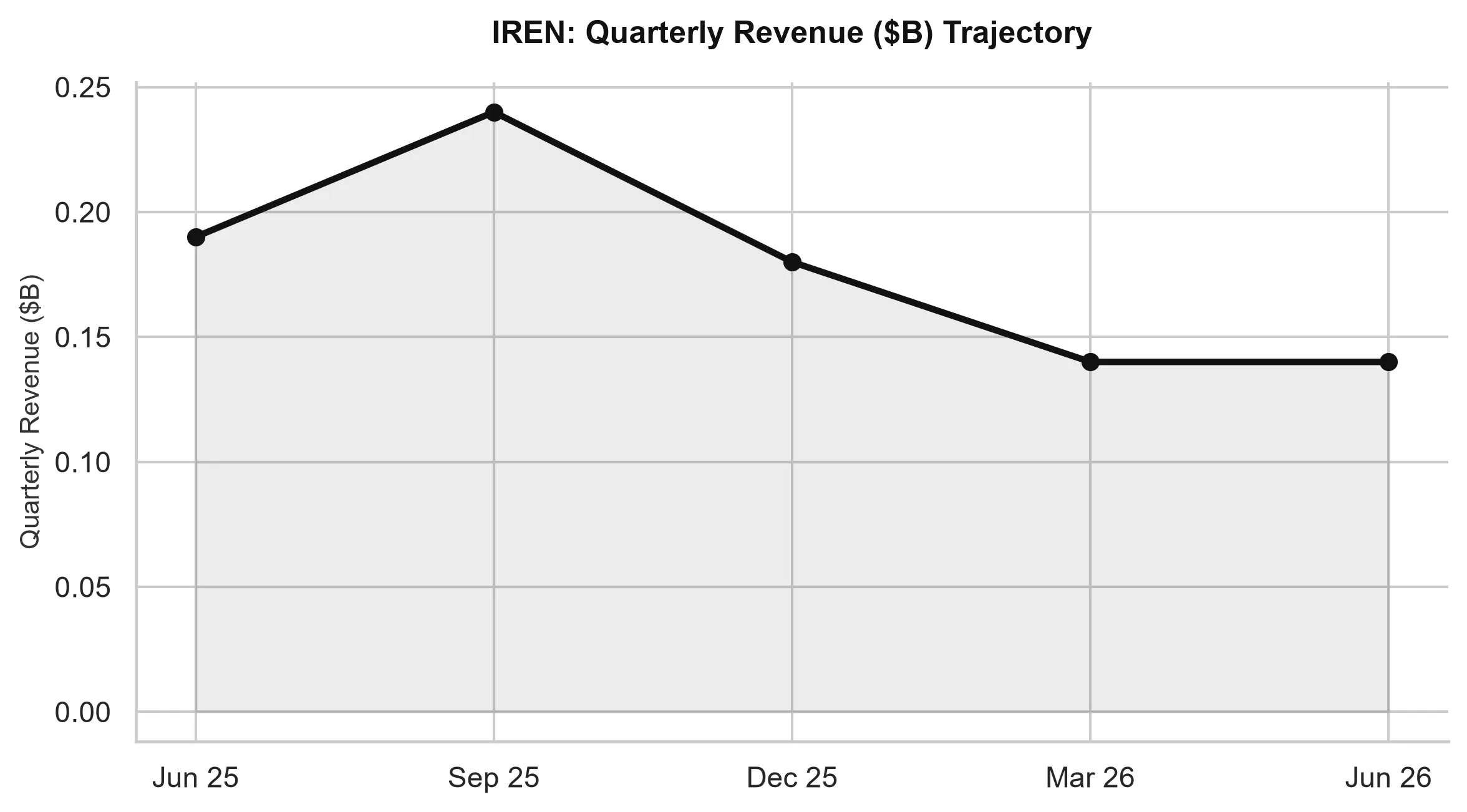
The valuation disconnect here is extraordinary.
IREN generates $707.01 million in revenue. For this top-line stream, the market assigns an enterprise value of $17.19 billion, an EV/Revenue multiple of 24.31x and an EV/EBITDA multiple of 448.28x. That multiple is richer than established enterprise software monopolies.
Yet the underlying business reported a GAAP net loss of -$702.62 million, an operating margin of negative 102.47%, and top-line revenue that contracted by 26.70% year-over-year as post-halving mining economics compressed cash flows.
Forensic Audit: The $4.2 Billion Cash Burn and Dilution Engine
When forensic analysts examine a transition story, the critical question is simple: how is the transition actually being financed?
1. The Capital Expenditure Black Hole
Over the trailing twelve months, IREN reported Free Cash Flow of negative $4.22 billion.
To put that figure in context: IREN burned through six times its entire annual revenue in capital spending. Transforming bare-bones, air-cooled Bitcoin mining sheds into tier-four, mission-critical, liquid-cooled enterprise data centers requires staggering amounts of cash.
You cannot simply put an Nvidia GB200 rack into a steel shed designed for loud, dust-tolerant crypto mining rigs. Enterprise clients like Microsoft, Anthropic, or Meta require redundant power supplies (N+1 or 2N UPS systems), direct-to-chip liquid cooling loops, ultra-low-latency dark fiber connectivity, and SOC 2 Type II physical security compliance.
2. The Debt Build-Up
To fund this cash burn, IREN expanded its total debt obligations to $7.84 billion. While the company holds $5.90 billion in cash, giving it a cushion to continue building, its net debt position sits near $1.94 billion. In a 5.2% interest rate environment, servicing this capital structure creates an ongoing cash drain that cannot be satisfied by legacy mining operations.
3. Accounts Receivable Red Flag
A forensic screen of IREN’s balance sheet reveals a notable anomaly: accounts receivable growth significantly outpaced revenue growth over recent operating cycles. In capital-intensive transitions, uncollected receivables often signal customer payment delays or aggressive revenue recognition on initial hosting pilots.
The Core Thesis: Sheds vs. Real Cloud Infrastructure
The bull thesis for IREN rests entirely on scarcity value: if tech giants cannot find grid-connected power anywhere else, they will pay whatever it takes to lease IREN’s Texas and Canadian megawatts.
However, institutional investors must distinguish between three very different business models:
- Colocation Landlord: Leasing powered land and shell buildings to hyperscalers who bring their own servers. This is a low-margin, utility-like real estate business.
- GPU Cloud Operator (Neocloud): Buying billions of dollars worth of Nvidia GPUs, building software virtualization layers, and renting compute per hour. This is a high-risk, hardware-depreciation treadmill where GPUs lose half their economic value every two years.
- Legacy Bitcoin Miner: Running ASICs on fluctuating spot hashprice economics.
Right now, IREN is valued as if it is successfully executing an enterprise AI cloud platform with infinite pricing power. But its financial reality is a company with a negative 102% operating margin, declining top-line revenues, $7.84 billion in debt, and a $4.2 billion annual cash burn.
If hyperscalers decide to build their own dedicated nuclear or off-grid gas generation, or if the pace of AI frontier model training consolidates into fewer, larger players, the anticipated tidal wave of enterprise lease demand for retrofitted mining sites will fail to clear at premium rates.
📊 AllWallSt Investment Verdict
| Company / Ticker | Rating | Word/Horizon |
|---|---|---|
| IREN Ltd (IREN) | SELL / HIGH SPECULATION | 12 to 18 Months |
Conviction rating derived deterministically from Layer 3 metrics, options flow, and fundamental review.
The Strategic Takeaway
IREN has executed a masterclass in market narrative navigation. By repositioning its power pipeline from Bitcoin mining to artificial intelligence high-performance computing, management unlocked an enterprise valuation of $17.19 billion.
However, financial markets ultimately enforce physical reality.
Operating at a negative 102% operating margin while burning $4.22 billion in cash requires perpetual external capital injections. With total debt approaching $8 billion and benchmark borrowing costs firm at 5.2%, equity investors paying 24 times sales for an unproven AI colocation thesis are bearing severe structural downside risk.
Power is valuable, but power without profitable unit economics is just an expensive utility bill.
Sources & References
- Primary SEC Disclosures: U.S. Securities and Exchange Commission EDGAR – IREN Ltd / Iris Energy (CIK 0001878848)
- Investor Relations: IREN Investor Relations Portal
- Macroeconomic & Market Data: Federal Reserve Bank of St. Louis (FRED), Chicago Board Options Exchange (CBOE), and U.S. Department of the Treasury.
- Deterministic Calculations: Metrics calculated deterministically via Python automated pipelines from official SEC Form 20-F and 6-K filings.
Disclaimer: This research brief is compiled for institutional research and educational purposes only and does not constitute financial, investment, legal, or tax advice. The securities analyzed carry substantial capital risk, leverage, and volatility. Readers should conduct independent due diligence before making investment decisions.