
The central dogma of the current stock market is that people like food, but they like being thin even more, and they will pay almost any price to have a pharmaceutical company mediate the difference.
If you tune into financial television between market open and lunch, you will hear a version of this story told with theological conviction. Eli Lilly and Company (LLY) is not merely a drug company. In the consensus imagination, it is an enterprise software platform that charges a monthly subscription fee directly to human metabolism. Because obesity affects more than one hundred million Americans, and because the clinical efficacy of dual GIP and GLP-1 receptor agonists like tirzepatide (sold as Mounjaro for diabetes and Zepbound for weight loss) is undeniably impressive, the market has reached a unanimous conclusion: Eli Lilly has conquered biology, and the cash register will ring forever.
This consensus has propelled Eli Lilly past a $1.04 trillion market capitalization and an enterprise value of $1.10 trillion. It has made Lilly the most valuable healthcare company on earth, trading at a valuation that dwarfs the gross domestic product of most mid-sized sovereign nations.
The consensus is intoxicating. It is also ignoring arithmetic.
The 5.22% Cost of Capital Reality
Here is the basic accounting reality. Over the trailing twelve months, Eli Lilly generated $79.67 billion in total revenue and converted that into $26.71 billion in GAAP net income, reflecting an extraordinary gross margin of 83.40% and an operating margin of 54.22%. Those are fabulous numbers. They look like the financial results of a Silicon Valley cloud provider during the zero-interest-rate era.
However, when you move down the cash flow statement to the line that actually matters to equity owners, you find that Eli Lilly generated $11.07 billion in free cash flow.
Now compare that cash flow to the price tag. On an enterprise value of $1.10 trillion, $11.07 billion in free cash flow represents a free cash flow yield of exactly 1.01%. On equity value alone, the yield is 1.06%. Put differently, investors are currently paying roughly 94 times free cash flow to own the business.
In 2021, when the Federal Reserve set the cost of capital at zero and risk-free Treasuries paid 1.2%, paying 94 times cash flow was a popular sport. But right now, the yield on the 10-Year US Treasury (^TNX) sits at 5.22%.
Think about what that spread requires. If you park money in 10-year US sovereign debt, the federal government hands you 5.22% every year with zero operating risk, zero patent expirations, and zero regulatory scrutiny. If you buy Eli Lilly at $1,168 per share, you receive a cash yield of 1.01%, accompanied by $54.91 billion in corporate debt and the operational hazards of running a global biochemical manufacturing complex.
To break even against a risk-free benchmark yielding 5.22%, Eli Lilly does not just need to grow. It needs to compound its free cash flow at more than 20% annually for the next decade without suffering a single regulatory setback, manufacturing bottleneck, or price concession.
The Manufacturing Treadmill: Drugs Are Not Software
The core intellectual error of the GLP-1 consensus is treating peptide synthesis like software distribution.
When Microsoft sells an additional license of Office 365, the marginal cost of production is approximately zero. The software is copied onto a server, and the gross margin translates directly into cash. When Eli Lilly sells an additional box of Zepbound auto-injectors, the company must manufacture sterile peptide chains, formulate them into stabilized liquid solutions, synthesize specialized glass carpules, and assemble precision plastic mechanical injection pens in heavily regulated cleanrooms.
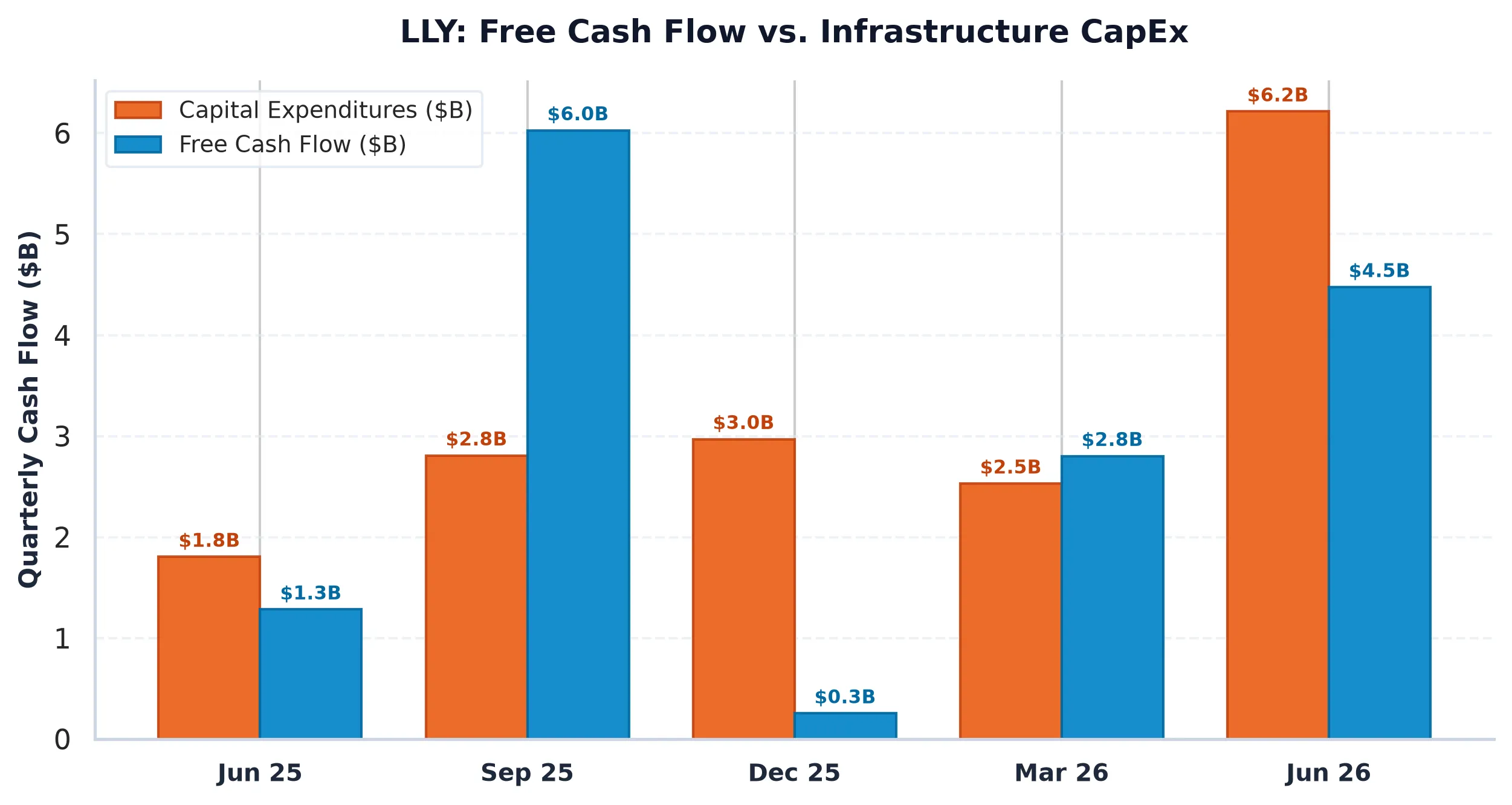
This distinction explains why Lilly’s free cash flow ($11.07 billion) is less than half of its GAAP net income ($26.71 billion). Eli Lilly is engaged in one of the most capital-intensive manufacturing expansions in corporate history.
To satisfy global demand and alleviate chronic drug shortages, the company has had to commit tens of billions of dollars to physical plant construction in Indiana, North Carolina, Virginia, and Germany. Unlike software code, these sterile manufacturing facilities take four to five years to construct, validate, and clear through FDA inspections.
To fund this expansion, Eli Lilly has built a balance sheet with $54.91 billion in total debt against just $8.95 billion in cash, leaving the firm with roughly $46 billion in net debt. This is not capital-light digital alchemy. It is heavy industrial manufacturing, financed with significant leverage in a 5% interest rate world.
The Compounding Gray Market and the Price Wall
The second flaw in the consensus narrative is the assumption of pricing permanence.
In the United States, brand-name GLP-1 treatments carry list prices of approximately $1,050 to $1,350 per month. But very few human beings actually pay $14,000 per year out of pocket for decades.
To achieve mass commercial adoption, drugmakers rely on two entities: commercial health insurers and Pharmacy Benefit Managers (PBMs). To convince PBMs like CVS Caremark, Express Scripts, and OptumRx to grant formulary placement, pharmaceutical companies routinely surrender 40% to 50% of the list price in confidential rebates. The gross-to-net haircut is severe.
More importantly, employers are rebelling. Self-insured corporate health plans, which cover the majority of working Americans, are facing double-digit health benefit cost inflation. A mid-sized employer with 10,000 workers cannot afford to pay $10,000 annually for 1,500 employees to take weekly injections indefinitely. Across corporate America, plan sponsors are introducing strict prior authorizations, lifetime caps, or dropping weight-loss coverage altogether.
Meanwhile, the compounding pharmacy sector has blown the doors off the pricing illusion. Exploiting official FDA drug shortage declarations, compounding pharmacies and venture-backed telehealth platforms have been selling compounded tirzepatide and semaglutide directly to consumers for $199 to $299 per month.
Even as Lilly works tirelessly to resolve FDA shortage lists and shut down compounders with litigation, the market signal is unmistakable: millions of consumers have discovered that the effective marginal clearing price of weekly peptides is roughly 75% lower than the list price Lilly needs to justify a $1 trillion enterprise value.
The Oral Horizon: The Commoditization Clock
Finally, there is the competitive lifecycle.
Right now, tirzepatide enjoys a commercial sweet spot: it is more potent than Novo Nordisk’s semaglutide (Wegovy), and manufacturing capacity is tight enough to preserve artificial pricing discipline. But this moat is temporary.
Every major pharmaceutical powerhouse on the globe (including Roche, Pfizer, AstraZeneca, Structure Therapeutics, and Viking Therapeutics) is racing to develop next-generation oral small-molecule GLP-1 pills. A daily tablet does not require cold-chain refrigerated distribution, does not require sterile plastic auto-injector pens, and can be manufactured in standard tablet factories at pennies per dose.
Eli Lilly has its own promising oral molecule, orforglipron, in Phase 3 trials. But when oral small molecules reach the market over the next three to five years, the specialized mechanical auto-injector moat will evaporate. At that point, GLP-1 will transition from an exotic injectable luxury to a standard oral maintenance therapy, subject to typical pharmacy price erosion and aggressive payer negotiation.
The Valuation Verdict
Eli Lilly is a world-class pharmaceutical enterprise executing brilliant science. Its dual-agonist platform is saving lives and transforming chronic disease management.
However, there is a fundamental difference between an extraordinary company and an investment that makes sense at 94 times free cash flow. At a $1.04 trillion market capitalization and a 1.01% free cash flow yield, the stock is priced for an immaculate monopoly that will never face payer backlash, generic compounding erosion, or manufacturing margin contraction.
In a world where cash in the bank yields 5.22%, the hurdle rate for perfection has never been higher. When consensus assumes that an entire sector can eat its cake and stay thin forever, institutional investors are better served watching from the sidelines.
📊 AllWallSt Investment Verdict
| Company / Ticker | Rating | Word/Horizon |
|---|---|---|
| Eli Lilly and Company (LLY) | HOLD | 12-18 Months |
Conviction rating derived from quantitative fundamental models, options open interest distribution, and primary SEC filing review.
Sources & References
- Eli Lilly and Company Investor Relations
- SEC EDGAR Form 10-K & 10-Q Primary Filings
- U.S. Department of the Treasury Daily Par Yield Curve Rates
- U.S. Food & Drug Administration Drug Shortage Database
Disclaimer: This research note is published solely for informational and institutional educational purposes and does not constitute personalized investment advice or an offer to buy or sell securities. Valuation estimates and market structure interpretations reflect prevailing conditions at publication time.