

The market loves a good redemption story, especially one wrapped in cloud software jargon and priced for absolute perfection. Snowflake Inc. (SNOW) currently changes hands at an eye-watering 89.3x forward earnings multiple, a valuation that assumes every enterprise on earth is about to double its cloud data consumption. Street analysts point to recent top-line momentum and enterprise client wins as proof that the software maker has turned a permanent corner. Yet beneath the glowing broker reports and optimistic television hits, the cold mechanics of cash generation tell a far more sobering story about what shareholders are actually paying for.
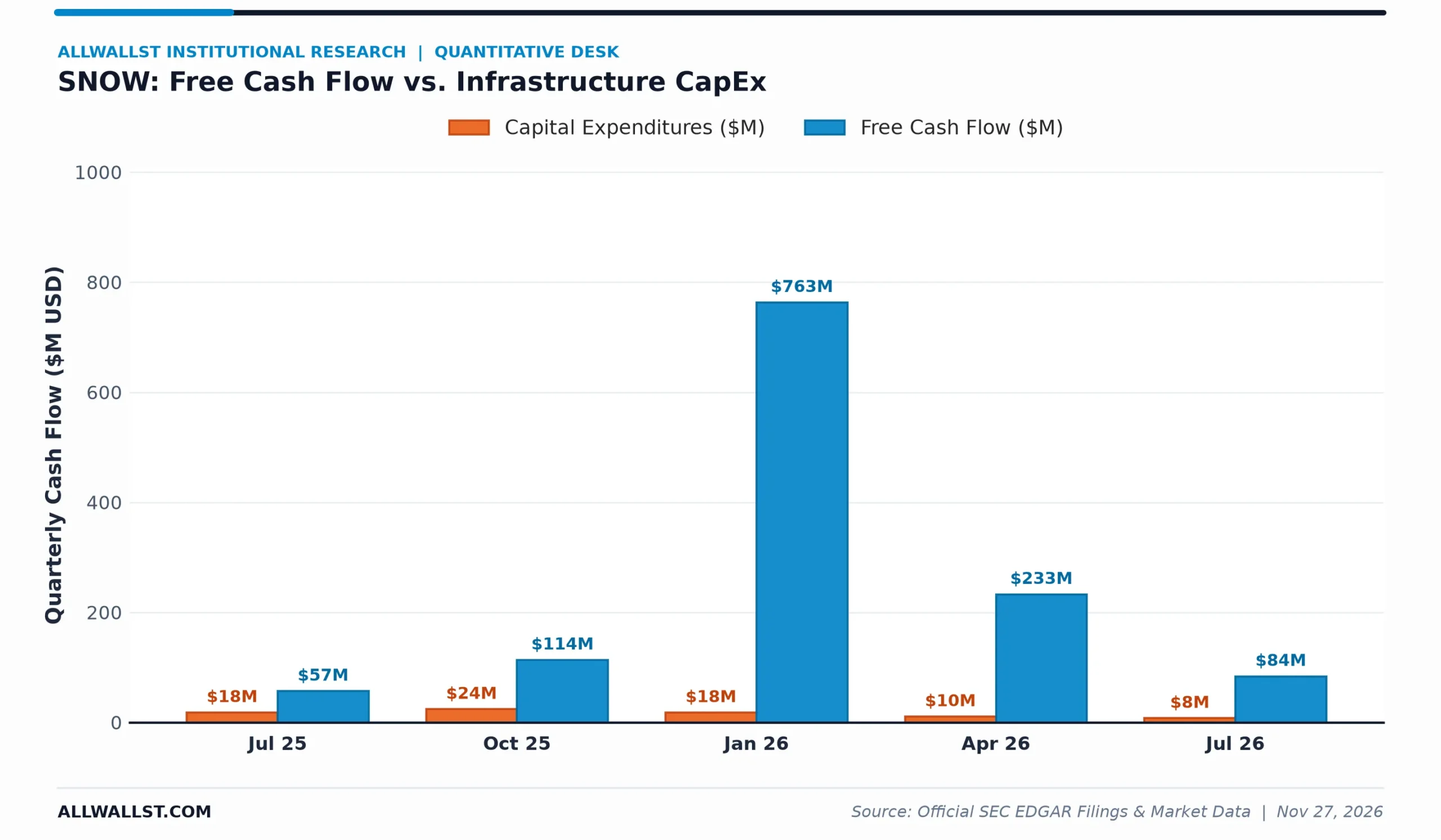
The Accounting Illusion Behind Cash Flow Generosity
When management celebrates headline operating cash flow, it sounds like a triumph of software economics until you check the stock-based compensation line item. Over the trailing twelve months, Snowflake generated $1.19B in reported Free Cash Flow while doling out $1.60B in share-based compensation to its engineering and executive talent. If you subtract those freshly printed equity grants from real cash generation, the company actually burned $-0.41B, resulting in a negative real Free Cash Flow yield of -0.47%.
This dilution machine means outside shareholders are slowly having their ownership stakes shaved away to pay for software talent in paper receipts. Meanwhile, the balance sheet sits exposed to refinancing friction and capital intensity that standard consensus models conveniently gloss over. When a business trades at a price-to-book ratio of 45.24x while posting an operating margin of -22.43%, any stumble in consumption revenue growth transforms a high-multiple compounder into an expensive value trap.
Growth-Adjusted Valuation and the Peer Group Reality
To understand why this multiple sits on shaky ground, we need to compare Snowflake directly against its peers in the high-growth software arena. While Palantir Technologies trades at a steep valuation, it combines hyper-growth with positive GAAP operating profitability and a massive federal contract moat.
| Company (Ticker) | Market Cap | Forward P/E | EV/EBITDA | Rev Growth (YoY) | Operating Margin | FCF Yield |
|---|---|---|---|---|---|---|
| Snowflake (SNOW) | $97.4B | 89.3x | N/A | 35.10% | -22.43% | 1.23% |
| Palantir Technologies (PLTR) | $413.7B | 67.6x | 114.4x | 95.9% | 45.6% | 0.64% |
| Datadog (DDOG) | $58.8B | 51.2x | 312.5x | 35.2% | 2.4% | 1.81% |
| MongoDB (MDB) | $25.5B | 39.9x | N/M (>500x) | 30.5% | -0.5% | 2.20% |
The data reveals a stark reality: Snowflake commands a forward P/E of 89.3x despite generating negative operating income and lagging behind peers on real cash returns. Competitors like Datadog and MongoDB offer comparable or superior top-line expansion with far less accounting distortion from equity dilution. Paying nearly ninety times forward earnings for a cloud data warehouse that consumes more in employee stock grants than it generates in true cash flow defies basic arithmetic.
Options Plumbing and the Near-Term Gamma Trap
Market plumbing right now offers little comfort to bulls hoping for a short squeeze. Options positioning reveals a balanced Put/Call open interest ratio of 0.88, clustered tightly around a Max Pain strike of $272.50. Max Pain represents the strike price where the highest cumulative dollar value of options contracts expires worthless, acting as a powerful gravitational pull during quiet consolidation weeks.
Options market makers currently sit in a neutral gamma profile, meaning they do not face urgent mechanical incentives to chase the stock higher or lower. However, formidable call resistance sits at the $280 and $300 structural walls, where heavy call selling creates a natural ceiling. With an implied volatility of 82.11% pricing in an expected 30-day move of +/-23.54%, the options market is signaling massive binary risk heading into the next earnings print. If consumption growth shows even a minor tick downward, those out-of-the-money put walls near $250 will become the next logical testing ground.
Navigating the Downside Asymmetry
The bull case rests entirely on the assumption that enterprise artificial intelligence workloads will drive an accelerated wave of unstructured data migration into Snowflake databases. Yet even if that consumption narrative materializes, the equity price already discounts years of flawless execution in an environment where the risk-free rate sits at 4.93%. When you can earn over four percent safely in government bonds, paying an 89x multiple for a dilutive enterprise software maker requires an extraordinary margin of safety that simply does not exist here.
Bulls can steelman that elite consumption growth and multi-cloud stickiness could surprise on the upside, forcing sidelined institutional funds to chase a breakout through the $300 call wall. Unfortunately, paying a premium for a business that relies on continuous equity dilution to fund operations leaves zero room for macro friction. We rated Snowflake SELL previously at higher multiples, and recent Form 8-K filings detailing convertible note structures only reinforce our conviction.
Investment Committee Steelman Dissent: The bull case contends that enterprise AI adoption will supercharge data storage consumption far beyond current consensus estimates, compressing forward multiples rapidly as operating leverage finally materializes. However, this optimistic scenario ignores the persistent headwind of massive stock-based compensation diluting per-share gains.
AllWallSt Investment Verdict: SELL (Reiterate SELL)
Snowflake Inc. (SNOW)
Sources & References
- AllWallSt Proprietary Desk: Live Dealer Gamma Matrix & Options Pinning
- Official SEC Form 10-K Annual Report (Filed 2026-03-20)
- Official SEC Form 10-Q Quarterly Report (Filed 2026-09-04)
- SEC EDGAR: Snowflake Inc. Complete Filing History
- SEC Form 8-K Exhibit 99.1 (Press Release / Earnings) (2026-10-02)
- SEC Form 8-K Primary Filing Body (2026-07-16)
- SEC DEF 14A Proxy / M&A Filing (2026-05-18)
- Federal Register (2026-08-21): Changes in Flood Hazard Determinations
- Federal Register (2026-07-22): Notice Pursuant to the National Cooperative Research and Production Act of 1993-The…
- Federal Docket: LaPuma v. Snowflake Inc. (2026-11-02)
- SEC EDGAR: Snowflake Inc. Form 10-K (Filed March 20, 2026)
- SEC EDGAR: Snowflake Inc. Form 10-Q (Filed September 4, 2026)
- SEC EDGAR: Snowflake Inc. Form 8-K Material Event Disclosures (Filed October 2, 2026)
- Snowflake Investor Relations: https://www.snowflake.com
Regulatory Disclaimer: This report is prepared solely for informational and educational purposes and does not constitute investment advice, a solicitation, or an endorsement to buy or sell any security. All analytics reflect quantitative data sourced from primary regulatory filings and live market feeds as of November 27, 2026. Readers should perform their own due diligence before allocating capital.