
The current theology of modern finance is that everything is secretly an artificial intelligence company.
For a while, this applied only to software firms that slapped a chatbot onto customer service portals. Then it applied to semiconductor designers, server rack assemblers, power utility operators, and natural gas pipeline companies. Now, inevitably, it has reached the people who dig rocks out of the ground.
The prevailing consensus across Wall Street research desks this morning is simple, elegant, and almost entirely untroubled by arithmetic. It goes like this: Artificial intelligence requires data centers. Data centers require electrical substations. Electrical substations require transformers, switchgear, and thick transmission cables. Thick transmission cables require red metal. Therefore, Freeport-McMoRan Inc. is no longer a cyclical basic materials company exposed to global smelting bottlenecks and Indonesian export permits. It is, according to the narrative, a secular growth titan destined to collect an unavoidable toll on human technological progress.
It is a lovely story. It has propelled Freeport-McMoRan to an enterprise value of $122.39 billion and a market capitalization of $99.90 billion, leaving the stock changing hands at roughly $69.57 per share. That prices the company at 34.27 times trailing twelve-month earnings and a price-to-earnings-growth ratio of 4.31.
Those are magnificent multiples. They are the kinds of multiples usually reserved for asset-light software monopolies with gross margins north of 80 percent and zero capital expenditures. Freeport-McMoRan, by contrast, operates enormous open-pit and underground mines in Indonesia, Arizona, and South America. Digging giant holes in the earth is many things, but it is rarely asset-light.
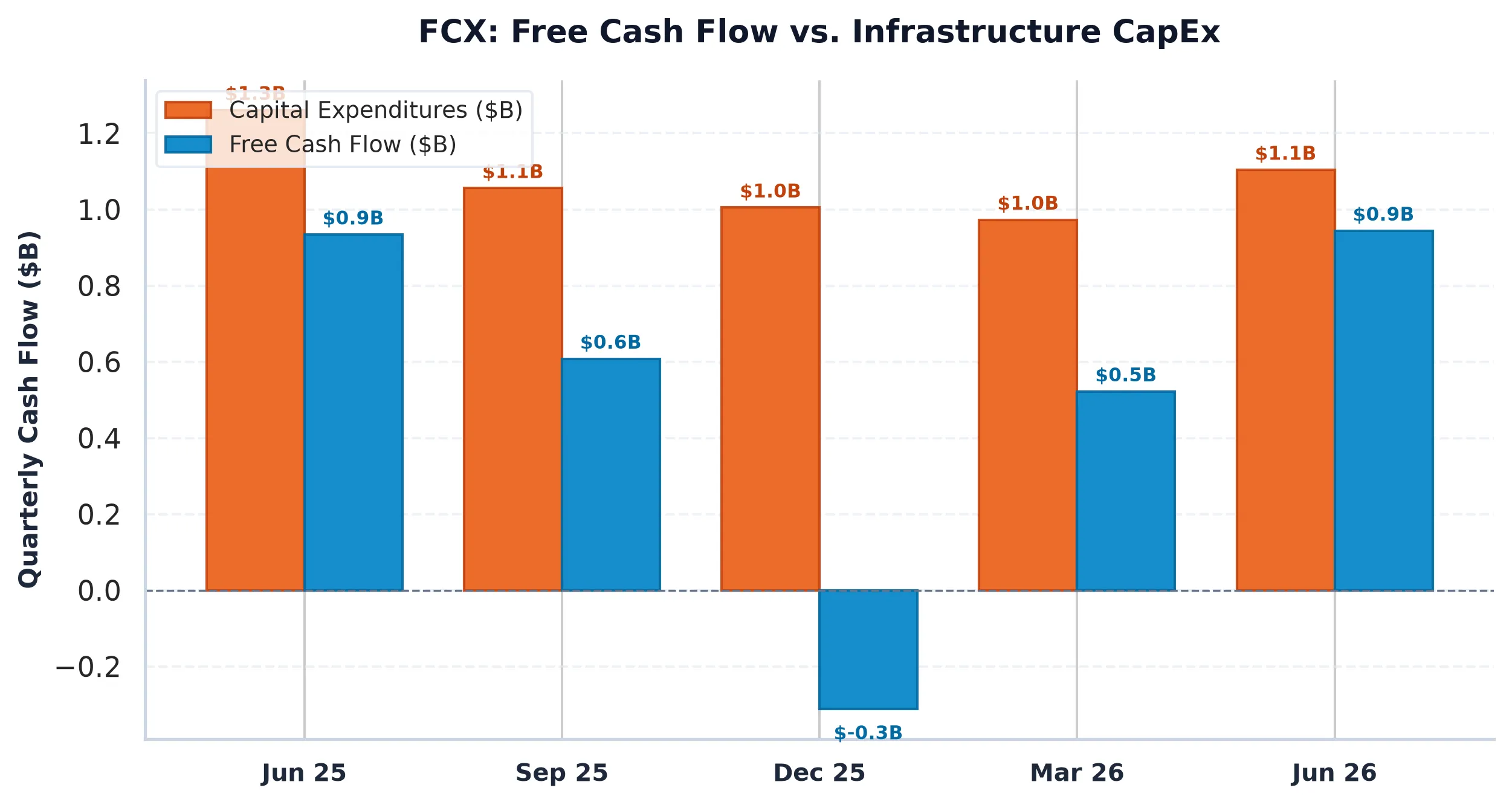
The Arithmetic of Secular Fantasy
If you examine the actual operating statements of Freeport-McMoRan Inc. rather than the thematic slide decks distributed by sell-side brokers, the picture looks somewhat more terrestrial.
Over the trailing twelve months, Freeport-McMoRan generated $25.87 billion in revenue. That represents a year-over-year revenue contraction of 7.30 percent. Net income arrived at $2.94 billion, yielding a net profit margin of 11.39 percent. Free cash flow came in at $2.16 billion.
Consider that free cash flow number for a moment. On a $122.39 billion enterprise value, a free cash flow generation of $2.16 billion translates to a free cash flow yield of roughly 1.76 percent.
To put that into perspective, the 20-year United States Treasury bond currently yields more than four percent without requiring you to blast thousands of tons of ore out of the Grasberg minerals district in Papua, load it onto conveyor belts, float it through concentrating plants, ship it across the Pacific Ocean, negotiate smelting fees with Asian processors, and pay export duties to sovereign governments.
The consensus defense of this valuation is that historical numbers do not matter because the impending supply deficit will cause copper prices to double. Forward earnings projections put the stock at 16.08 times forward earnings. That assumes everything goes right: copper prices stay elevated, unit net cash costs remain disciplined, downstream smelter capacity expands without friction, and global demand outside of artificial intelligence remains pristine.
That last assumption is where the narrative begins to wobble.
The Other Eighty-Five Percent
Data centers are indeed power-hungry. If you build a one-gigawatt data center campus, you will need a great deal of copper. Industry estimates suggest data centers might consume an incremental two to three million metric tons of copper globally by the end of the decade.
That sounds enormous until you remember that global refined copper demand is roughly 26 million metric tons per year. Data centers currently account for less than three percent of global consumption. Even under the most aggressive hyperscaler deployment roadmaps, digital infrastructure will account for a modest fraction of aggregate demand.
The rest of the world’s copper is consumed by boring things: residential plumbing in suburban developments, grid wiring for washing machines, air conditioning units in commercial office towers, and industrial manufacturing plants.
When you buy Freeport-McMoRan at 34 times earnings, you are not merely betting that artificial intelligence will boom. You are betting that the other 90 percent of copper demand, which is ruthlessly tethered to global industrial cycles, Chinese construction activity, and broader capital goods spending, will not experience a standard cyclical downturn.
If Chinese real estate investment continues to stagnate and global manufacturing purchasing managers indexes hover in contraction territory, all the data center cables in Virginia cannot absorb the slack. Mining companies have spent two centuries learning that marginal demand at the high end rarely offsets structural softness at the broad base.
Market Plumbing and the $70 Pin
The trading dynamics around Freeport-McMoRan illustrate how structural market mechanics can amplify a narrative far beyond its fundamental moorings.
Over recent weeks, institutional options flow has concentrated heavily around the $70 strike price. Call open interest has bunched tightly across the near-dated expirations, creating a classic positive gamma environment where options market makers must buy stock as it rallies toward $70 and sell stock as it slips below.
This mechanical dynamic creates an illusion of fundamental stability. Whenever the equity dips, dealer hedging dampens volatility. Retail and passive thematic exchange-traded funds, eager for exposure to the critical minerals trade, continue to channel liquidity into the largest, most liquid domestic proxy. Because Freeport-McMoRan is the primary mega-cap copper vehicle listed on a United States exchange, it becomes the default repository for every macro fund looking to express a generic bet on electrification.
The result is a self-referential loop. Flows enter the thematic ETFs, the ETFs buy Freeport-McMoRan regardless of whether its free cash flow yield is 1.7 percent or 0.5 percent, options dealers hedge the resulting volume, and market commentators point to the resilient stock price as definitive proof that the copper supercycle is accelerating.
Meanwhile, behind the curtain, Freeport-McMoRan carries $10.36 billion in total debt against $4.08 billion in cash reserves, leaving a net debt load of $6.28 billion. The balance sheet is reasonably managed, but it is not unencumbered. Every dollar spent on sustaining capital expenditures, deep underground development, and environmental remediation is a dollar that cannot be returned to shareholders via buybacks or dividends.
The Reality of Ore
There is a fundamental difference between a software company and a mining house. When a software company experiences a surge in demand, it spins up additional server instances at a marginal cost approaching zero. When a mining company experiences a surge in demand, it discovers that its existing deposits have declining ore grades, its haul trucks require replacement tires that take six months to arrive, its local workforce demands higher wages, and the host government wants to renegotiate the royalty framework.
Freeport-McMoRan is an exceptionally well-run mining enterprise. Its Grasberg operation is an engineering marvel, and its domestic leaching initiatives in the American Southwest show genuine technical promise.
However, trading at an EV-to-EBITDA multiple of 12.81 in a capital-intensive extractive sector leaves zero margin for geological or macroeconomic disappointment. If copper prices experience even a modest cyclical retreat due to broader industrial headwinds, earnings estimates will compress rapidly, leaving investors holding an industrial cyclical valued like an enterprise software platform.
The consensus believes Freeport-McMoRan has escaped the commodity cycle through the magic of artificial intelligence. The financial statements suggest it is still, stubbornly, a mining company.
📊 AllWallSt Investment Verdict
| Company / Ticker | Rating | Word/Horizon |
|---|---|---|
| Freeport-McMoRan Inc. (FCX) | HOLD | 12-18 Months |
Conviction rating derived from quantitative fundamental models, options open interest distribution, and primary SEC filing review.
Sources & References
- Freeport-McMoRan Inc. Investor Relations: https://investors.fcx.com
- United States Securities and Exchange Commission, Form 10-K and 10-Q Filings for Freeport-McMoRan Inc.
- International Copper Study Group (ICSG) Global Copper Supply and Demand Directives.
- London Metal Exchange (LME) and Primary Exchange Market Feeds.
Regulatory Disclaimer: The information and analysis provided in this article are for informational and educational purposes only and do not constitute financial, investment, legal, or tax advice. Past performance is no guarantee of future results. Consult with a qualified financial advisor before making any investment decisions.