
Corporate finance has a few classic moves that never go out of style. There is the share buyback to mask executive dilution, the “restructuring charge” that seems to happen every year, and my personal favorite: the tactical spin-off. On October 21, 2026, Abbott Laboratories (ABT) decided to perform the latter. The company announced via a Form 8-K filing that it plans to carve out its nutrition business into an independent entity.
In the polite world of investor relations, this is called “unlocking shareholder value” or “increasing strategic focus.” In the more cynical world of institutional reality, it often looks like creating a “bad bank.” By separating the embattled nutrition unit, which has spent the last few years navigating baby formula recalls and a thicket of litigation, Abbott Laboratories is attempting to shed its baggage. The goal is to leave behind a high-growth, high-multiple medical device and diagnostics pure-play that the market can love without reservation.
The Yield Gap Problem
The problem with this narrative is the math. While the market cheered the “cleaner” story, the fundamental valuation of Abbott Laboratories has drifted into a territory that is difficult to justify in a 5.1 percent interest rate environment. Currently, the company trades at a trailing P/E of 32.1. For a business growing revenue at 13 percent, that is a significant premium.
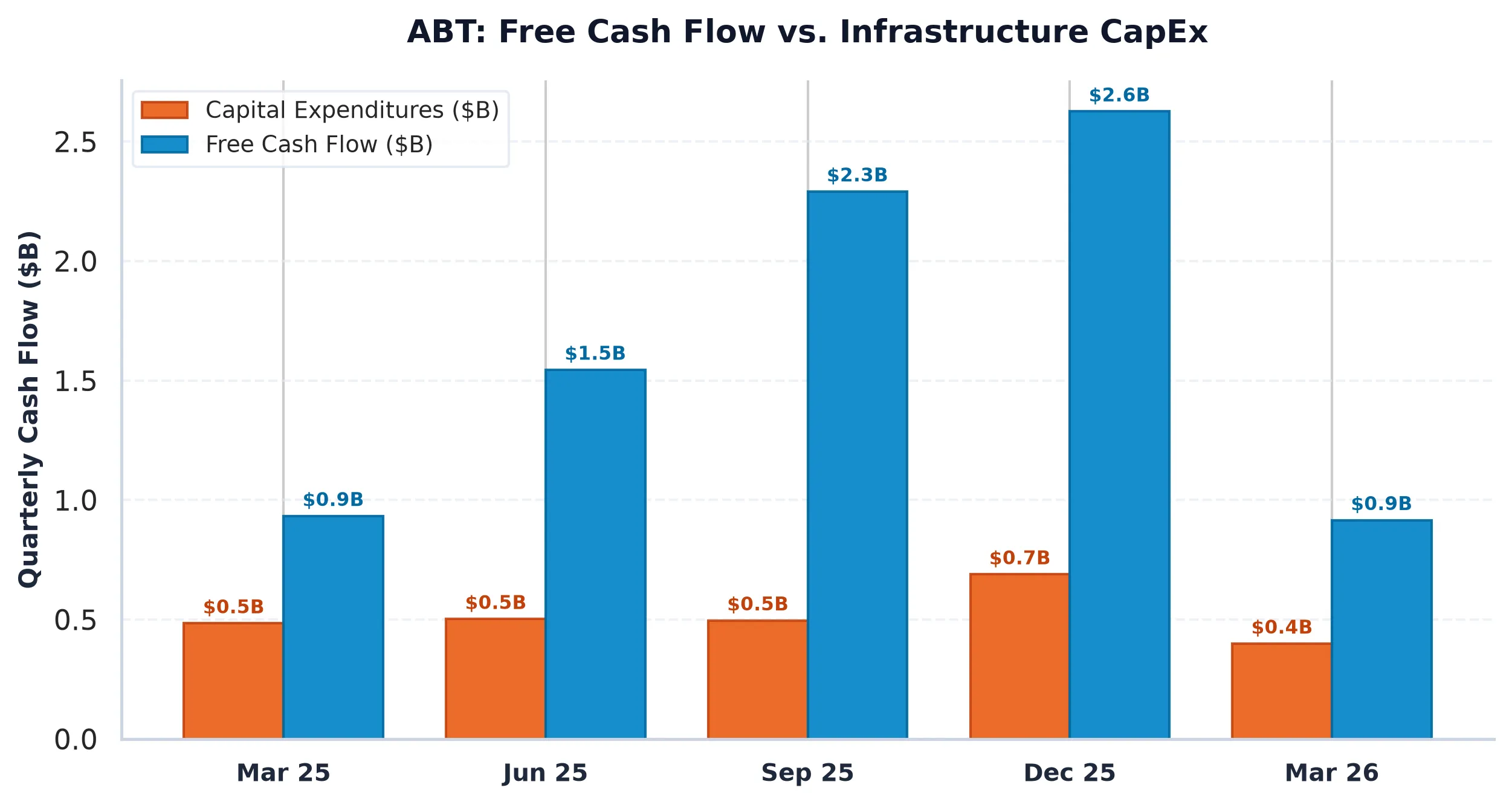
The real concern lies in the Free Cash Flow (FCF) yield. Based on the latest financial disclosures, Abbott generated approximately $7.21 billion in free cash flow. Against a market capitalization of $172.45 billion, that results in an FCF yield of 4.18 percent. Meanwhile, the US 10-Year Treasury yield is hovering around 5.08 percent.
When you buy a stock, you are supposed to be compensated for the risk of owning equity. Usually, that means the cash flow yield of the company should be higher than the yield of a risk-free government bond. Right now, Abbott Laboratories offers a negative spread of 90 basis points compared to Uncle Sam. You are essentially paying the company for the privilege of taking on its operational risks, litigation headaches, and $32.7 billion in total debt, all while receiving less cash return than a passive bondholder.
The CapEx Mirage and the Spin-off
The bull case for the spin-off is that the remaining medical device business will be a leaner, meaner machine. However, medical devices are capital-intensive. Abbott Laboratories currently maintains a CapEx intensity of 5.79 percent, spending $2.7 billion annually to keep the lights on and the innovation pipeline flowing. When the nutrition business departs, the remaining entity will likely need to maintain or even increase this intensity to compete with the likes of Dexcom or Medtronic.
There is also the matter of the balance sheet. Abbott carries $27.12 billion in net debt. In a spin-off, the parent company usually decides how much of that debt the new “independent” company has to take with it. If Abbott loads the nutrition business with debt to “cleanse” the parent, it might make the parent look better on paper, but it creates a fragile new entity that might struggle under the weight of its own interest expense. If they keep the debt at the parent level, the “high-growth” med-tech story is suddenly weighed down by a legacy interest burden.
Market Structure and the $103 Magnet
While the fundamental analysts debate the merits of baby formula vs. glucose monitors, the options market is busy doing its own thing. The current market structure for Abbott Laboratories shows a balanced but curious dealer profile. The Put/Call Open Interest ratio is 1.14, suggesting that institutional players are paying for a decent amount of downside protection.
The most interesting data point is the Max Pain strike at $103.00. With the stock currently trading near $99.66, there is a mechanical pull toward that $103 level as we approach expiration. Dealers will likely be forced to buy the underlying stock to hedge their positions if the price moves toward that strike, providing a temporary floor.
However, the implied volatility is sitting at a staggering 107.18 percent. This prices in a 30-day expected move of roughly 30 percent in either direction. For a blue-chip healthcare giant, that is an extraordinary level of anticipated turbulence. It suggests that while the “spin-off” headline sounds like a tidy conclusion, the market expects the actual execution to be messy.
The Institutional Trap
Institutional investors often hide in names like Abbott Laboratories because they are perceived as “safe” havens during macro volatility. But “safety” is a relative term. When the equity risk premium disappears, as it has here, the safety is an illusion.
The company is trading at an enterprise value of $205 billion, or roughly 17.5 times EBITDA. That is an expensive price to pay for a company that is currently in the middle of a massive structural identity crisis. Spinning off a troubled unit does not change the fact that the core business is being priced for perfection in an imperfect macro environment. If the “New Abbott” cannot immediately accelerate its margins beyond the current 14.7 percent operating level, the 32x multiple is going to look like a very long way down.
| Metric | Value |
|---|---|
| AllWallSt Investment Verdict | SELL |
| Price Target (12-Month) | $84.00 |
| Risk Profile | High (Valuation Compression) |
Abbott Laboratories (ABT)
Trailing P/E
Marcus Wolfe Screen
Leverage Profile
30D Channel
Pristine cash flow conversion (1.47x) and healthy accrual ratio (-3.51%). Zero accounting anomalies detected (LOW ANOMALY RISK).
Manageable liability structure relative to institutional cash flow.
Evaluated against 5.10% US 10-Yr Benchmark (FCF Spread: -0.90% (vs 10Y Yield of 5.08%)).
Max Pain: $103.00 (+3.35%) | P/C Ratio: 1.14 | 30D Channel: $92.52 – $106.80.
$91.69 – $95.67 (-4% to -8% Pullback Accumulation)
Sustained weekly close below $89.69 (-10.0% structural stop) or fundamental cash flow deterioration.