
The way an actively managed exchange-traded fund is supposed to work, at least in the glossy brochures, is that the manager identifies the future and buys it before everyone else realizes it is the future. If the manager is right, the fund goes up, everyone cheers, and the manager gets to do television interviews about the transformative power of innovation.
The way the ARK Innovation ETF (ARKK) actually works lately is a bit more like a high-stakes game of musical chairs where the music is provided by the federal funds rate and the chairs are being sold to buy more tickets to the concert.
In the last 48 hours, ARK Investment Management has been busy. The fund dumped shares of Taiwan Semiconductor Manufacturing Co. (TSMC) and Advanced Micro Devices (AMD). These are companies that actually make things, generate substantial cash flow, and sit at the center of the global computing architecture. In their place, the ARK Innovation ETF (ARKK) backed up the truck for Robinhood Markets (HOOD) after its stock slid 23 percent in a single session. It also spent three straight days buying Archer Aviation and Joby Aviation, companies whose primary business model involves making taxis fly, which is a noble goal but one that remains remarkably capital-intensive and pre-revenue.
The Duration Trap in a 5.10 Percent World
From a forensic perspective, the concern here is not that the ARK Innovation ETF (ARKK) is faking its numbers. The fund is an ETF, its holdings are transparent, and its net asset value is calculated by people who are very good at math. The concern is the internal logic of the portfolio construction.
When the 10-Year Treasury yield is sitting at 5.10 percent, the math for “innovation” changes. In a zero-interest-rate world, a dollar earned in 2035 is worth almost as much as a dollar earned today. In a 5.10 percent world, that future dollar is worth significantly less. By selling TSMC (which earns dollars today) to buy Archer Aviation (which hopes to earn dollars in the distant future), the fund is effectively increasing its “duration.” It is becoming more sensitive to interest rates at the exact moment the bond market is signaling that higher rates are the new permanent reality.
The equity risk premium for the ARK Innovation ETF (ARKK) is, for lack of a better term, imaginary. With a trailing P/E of 55.5 and a portfolio filled with companies that often lack traditional earnings entirely, the spread against the risk-free 5.10 percent yield is negative. You are paying a premium for the privilege of taking more risk than the benchmark, which is a difficult pitch to make to institutional capital.
Market Structure and the Put Wall
The options market seems to have noticed this disconnect. The Put/Call Open Interest ratio for the ARK Innovation ETF (ARKK) currently sits at a staggering 2.04. For every person betting the fund will go up, there are two people betting (or hedging) that it will go down. This is a defensive, almost bearish skew that suggests the market is bracing for another leg lower.
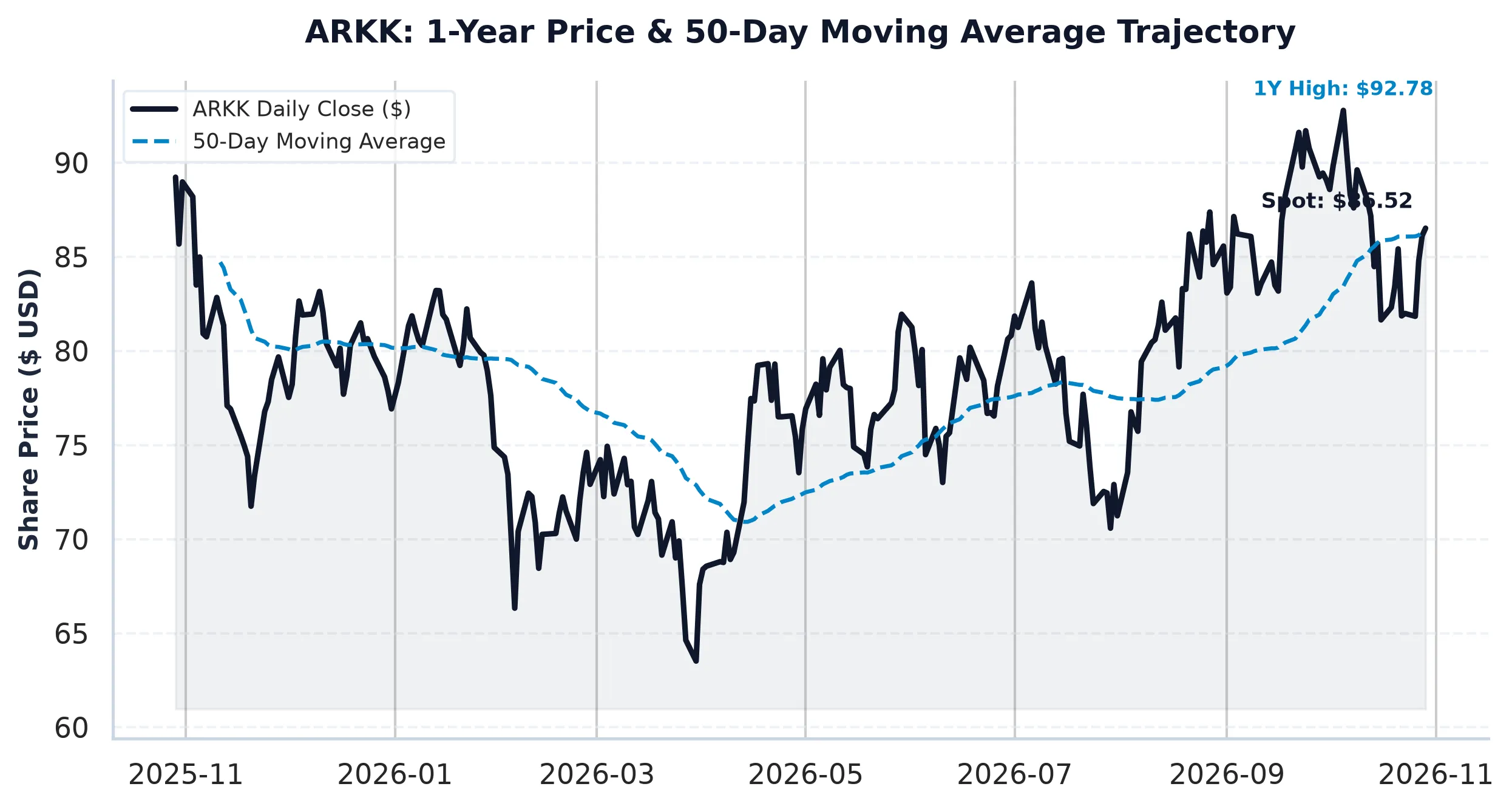
The “Max Pain” strike is currently $84.50, which is about 1.74 percent below the current price. In the world of market plumbing, this suggests that dealers are positioned in a way that creates a magnetic pull toward that level as we approach expiration. There is a massive Put Wall at $75, representing the structural floor where institutional support finally kicks in. Between here and there, however, the liquidity looks thin.
Auditing the Prior Thesis
Two weeks ago, we assigned a SELL rating to the ARK Innovation ETF (ARKK) at $82.06. Since then, the share price has drifted up to $86.00, but the underlying fundamentals have arguably deteriorated. The decision to exit “quality” growth like TSMC to fund “speculative” growth like Robinhood and eVTOL startups suggests a manager who is doubling down on a specific volatility profile rather than responding to the shifting cost of capital.
If you are selling the companies that provide the picks and shovels (semiconductors) to buy the companies that are still trying to figure out how to build the mine (flying taxis), you are not just betting on innovation. You are betting that the laws of physics and the laws of finance will both take a holiday at the same time.
The fund’s recent $9.1 million splurge on Robinhood after a 23 percent drop is the quintessential “catch the falling knife” maneuver. While it might lead to a short-term bounce, it does nothing to solve the structural problem of owning high-beta assets in a high-rate environment.
ARK Innovation ETF (ARKK)
Trailing P/E
Marcus Wolfe Screen
Leverage Profile
30D Channel
Pristine cash flow conversion (0.00x) and healthy accrual ratio (0.00%). Zero accounting anomalies detected (LOW ANOMALY RISK).
Manageable liability structure relative to institutional cash flow.
Evaluated against 5.10% US 10-Yr Benchmark; cross-asset discount rate hurdle audited.
Max Pain: $84.50 (-1.74%) | P/C Ratio: 2.04 | 30D Channel: $79.83 – $92.16.
ARKK operates with negligible index gravitational pull. Sell-side ratings reflect pure idiosyncratic fundamental consensus without passive indexing distortion.
$79.12 – $82.56 (-4% to -8% Pullback Accumulation)
Sustained weekly close below $77.40 (-10.0% structural stop) or fundamental cash flow deterioration.
Sources & References
- SEC EDGAR: ARK ETF Trust (CIK 0001579982)
- ARK Invest Official Daily Trade Disclosures
- U.S. Treasury Department: Daily Treasury Par Yield Curve Rates
Regulatory Disclaimer: This report is for informational purposes only and does not constitute financial, investment, or legal advice. The author is a financial journalist, not a registered investment advisor. At the time of publication, the author holds no positions in the securities mentioned. Investing in actively managed ETFs involves significant risk, including the loss of principal. Past performance is not indicative of future results. All data is sourced from primary SEC filings and exchange feeds.