

Corporate compensation committees have a wonderfully elastic sense of time. When business is booming, performance periods can be shortened so executives can celebrate early. When times are tough, targets are routinely redefined to preserve morale.
On November 27, 2026, Carnival Corporation Ltd. (CCL) filed an SEC Form 8-K disclosing an amended performance share agreement for Chief Executive Officer Josh Weinstein. Back in August 2022, the board granted Weinstein 500,000 performance-based restricted stock units designed to measure average return on invested capital through November 2027, with vesting set for February 2028. Under the amended terms, the board moved the finish line forward to November 30, 2026. Because Carnival projected the award to pay out at the maximum 200% performance cap, the change allows executive equity to vest next month rather than two years down the road.
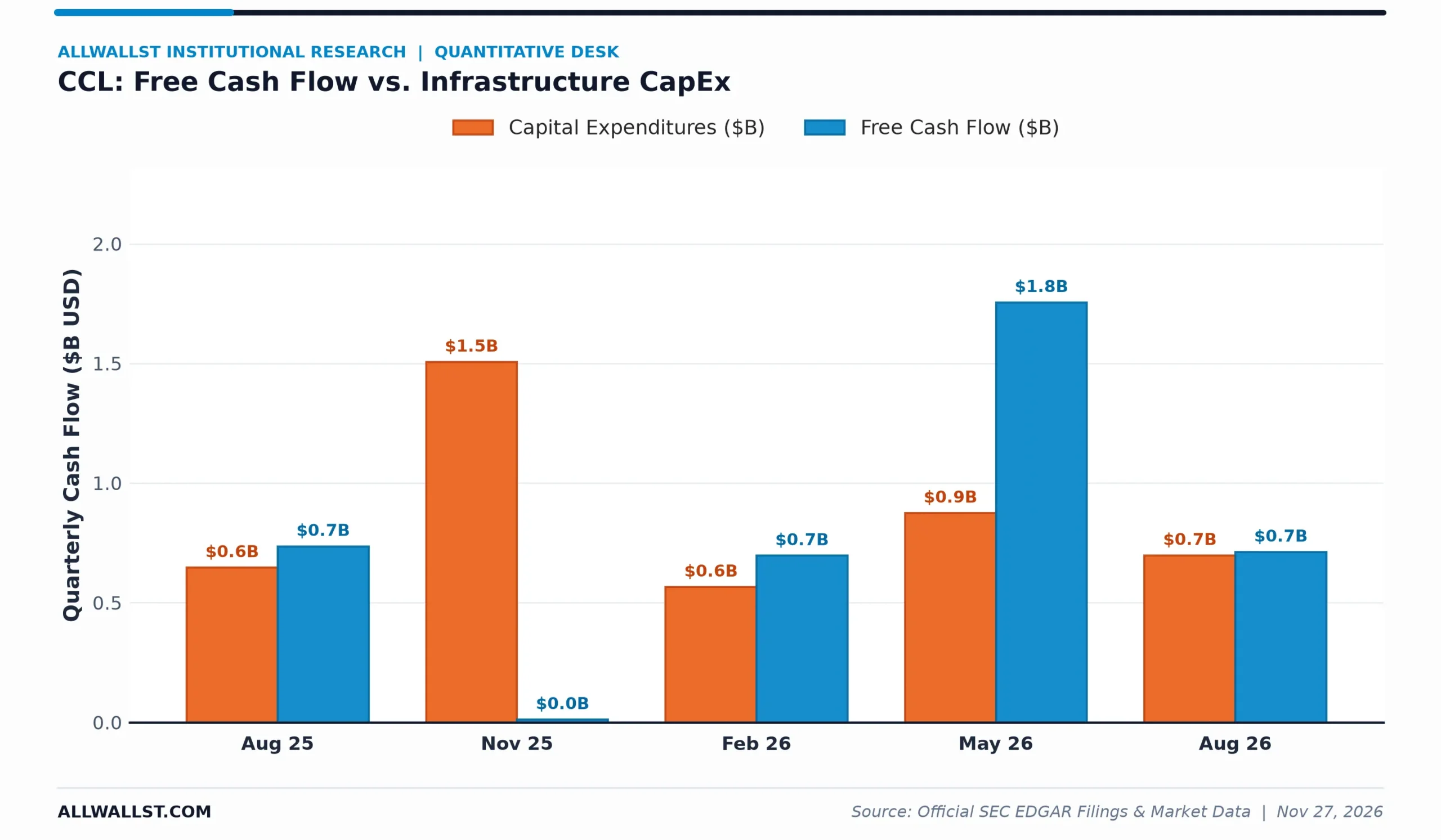
From an operational standpoint, management has certainly delivered a impressive turnaround. Revenue expanded from $12.17 billion in FY2022 to $26.62 billion in FY2025, restoring operating margins to 16.8%. The company generated $1.81 billion in trailing free cash flow ($1.71 billion after accounting for stock-based compensation), while return on invested capital reached 9.58%, comfortably clearing its estimated 8.5% cost of capital hurdle.
Yet, while C-suite incentive timelines are being accelerated, common equity holders face a far more deliberate reality.
Investors currently pay just $10.90 for every $1.00 of projected profit over the next 12 months (a 10.9x forward earnings multiple) and an enterprise multiple of 8.4x (8.4x EV/EBITDA). That valuation appears cheap compared to mega-cap consumer peers like Amazon (AMZN), which trades at 23.3x forward earnings despite generating a negative cash yield (-1.26% free cash flow yield after massive data center spending). Even retail compounding machines like Costco Wholesale (COST) command high multiples (43.8x forward earnings) on razor-thin operating margins (3.8%).
Carnival trades at a deep discount for a simple reason: the company carries $23.94 billion in net debt, leaving total debt outstanding at $25.16 billion. Total corporate borrowings exceed annualized earnings before interest and taxes by 3.28 times (3.28x Net Debt to EBITDA). With the US 10-Year Treasury yield offering a risk-free 4.94%, Carnival’s 4.79% free cash flow yield provides zero equity risk premium over government bonds (-0.15% yield spread).
Options Market Structure Pinning
Options market structure underscores why the stock remains bound to its recent trading corridor. Trading near $28.07, Carnival exhibits a defensive Put/Call open interest ratio of 0.56, indicating heavy upside call buying by speculative retail traders.
Options dealers (market makers) who sold those contracts are currently short upside call options. To hedge their books against rapid price increases, dealers are forced to sell shares as spot prices approach heavy overhead Call Walls at $29 (2,596 open contracts) and $30 (3,634 open contracts). This mechanical hedging creates a ceiling on upside momentum.
Conversely, structural support sits firmly at the $27 Put Wall (918 contracts), where options dealers buy underlying stock to hedge downside put options. With the options market’s point of maximum financial pain (the strike price where the highest number of options expire worthless) sitting at $28.50 and expected 30-day volatility bounded at +/- $4.51 (+/- 16.06%), price action is mathematically trapped between dealer hedging walls.
Carnival has successfully engineered an operational recovery, but untangling its massive leverage stack will take years of disciplined debt paydown. Pulling forward executive stock rewards acknowledges past operational milestones, but it does not remove the capital structure anchor holding shares near current levels.
Investment Committee Steelman Dissent: Bulls contend that continued strength in consumer travel demand could accelerate debt paydown faster than expected, reducing leverage below 2.5x EBITDA and unlocking a massive equity re-rating toward historical valuation multiples. Conversely, bears highlight that any contraction in discretionary household spending or spike in maritime fuel prices would leave Carnival’s high-leverage capital structure highly vulnerable to refinancing risk.
AllWallSt Investment Verdict: HOLD (Initiation)
Carnival Corporation Ltd. (CCL)
Sources & References
- AllWallSt Proprietary Desk: Live Dealer Gamma Matrix & Options Pinning
- Official SEC Form 10-K Annual Report (Filed 2026-01-27)
- Official SEC Form 10-Q Quarterly Report (Filed 2026-09-29)
- SEC Form 8-K Primary Filing Body (2026-11-04)
- SEC SCHEDULE 13D/A Beneficial Ownership Disclosure (2025-11-26)
- SEC DEFM14A Proxy / M&A Filing (2026-02-27)
- Federal Register (2026-10-27): Safety Zone; Southern California Annual Firework Events for the Los Angeles-Long Beach…
- Federal Register (2026-07-06): United States et al. v. Live Nation Entertainment, Inc.; Proposed Final Judgment and…
- SEC EDGAR: Carnival Corporation Ltd. Corporate Filings Directory
- Carnival Corporation & plc Investor Relations Portal
- U.S. Securities and Exchange Commission Form 8-K Disclosure (Nov 27, 2026)
Regulatory Disclaimer: All research and quantitative analysis published by AllWallSt is provided strictly for educational and informational purposes. Nothing contained herein constitutes investment advice, a solicitation, or an endorsement to buy or sell securities. Past financial performance is no guarantee of future returns.