
The marketing department at Coinbase Global, Inc. (COIN) is currently being outshone by an unlikely group of freelancers: the North Korean state sponsored hacking collective. News broke this week that Binance, the world’s largest cryptocurrency exchange and a perennial thorn in the side of domestic regulators, was hit for a record breaking $6.3 billion. In the traditional world of finance, losing $6 billion is generally considered a catastrophic event that ends in a federal takeover or a very long weekend at the Treasury Department. In the world of offshore crypto, it is just a particularly expensive Tuesday.
For Coinbase, however, this is a profound structural gift. The central tension of the crypto industry has always been the cost of compliance versus the speed of the wild west. Coinbase chose the expensive path of being a regulated, US domiciled, SEC reporting entity. This involves a lot of paperwork, a lot of lawyers, and a lot of uncomfortable conversations with Gary Gensler. Usually, these things are a drag on the bottom line. But when the alternative is having your customer deposits liquidated by a sovereign state’s cyber warfare division, the “compliance moat” starts to look like a very attractive piece of real estate.
The Cost of Staying Clean
The fundamental thesis for Coinbase Global, Inc. is that it is the only adult in the room. As institutional capital flees the radioactive debris of offshore platforms, Coinbase stands as the primary beneficiary of a flight to safety. This is not just about sentiment; it is about capital allocation. If you are a large pension fund or an institutional asset manager, you cannot risk your fiduciary duty on a platform that might vanish because of a faulty smart contract or a North Korean phishing email.
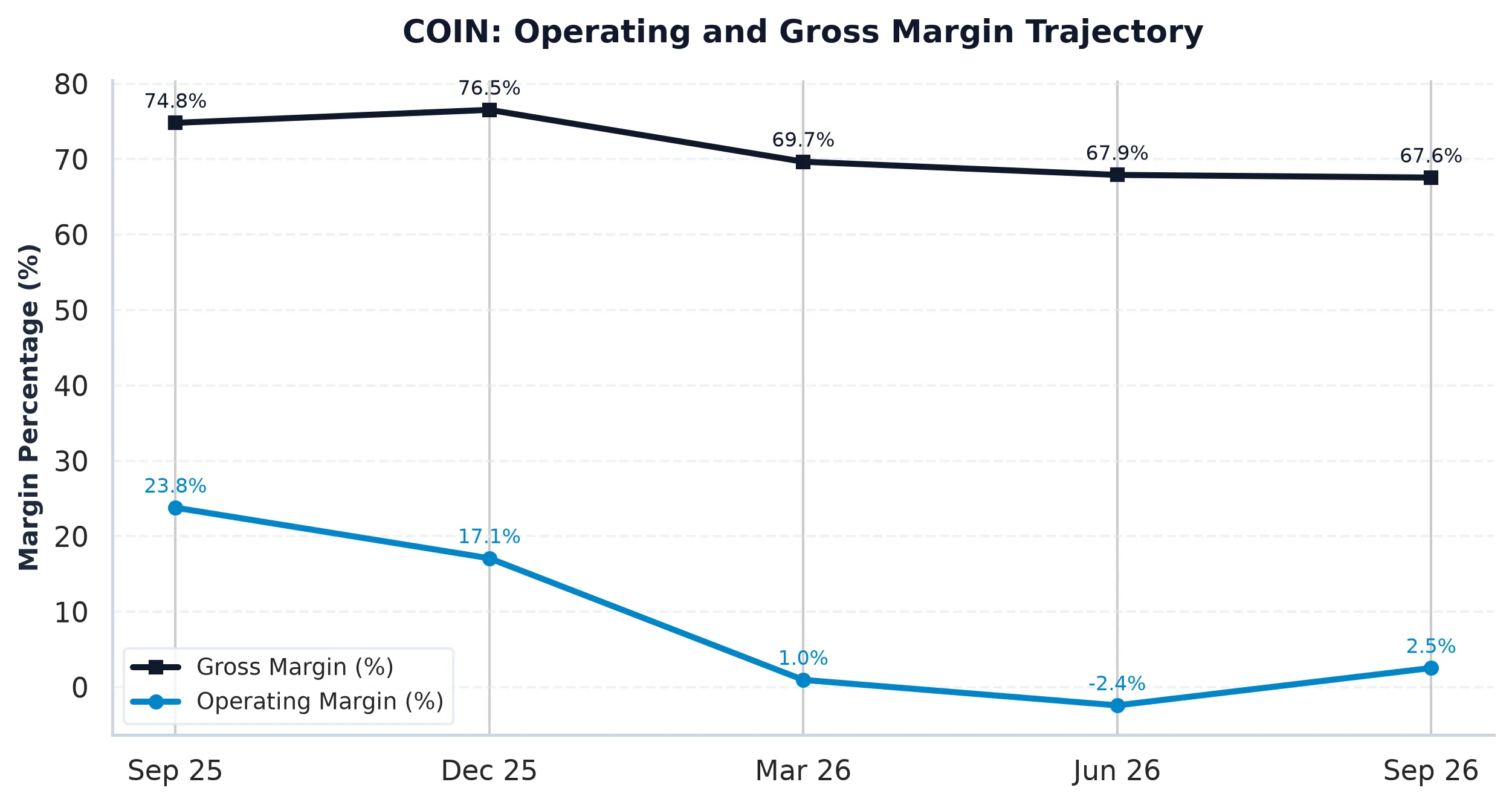
However, being the “safe” option is expensive. If we look at the financials, Coinbase is currently trading at a forward P/E of 45.6x. For context, the boring, traditional exchange giants like CME Group (CME) and Intercontinental Exchange (ICE) trade at 23.1x and 18.9x, respectively. Those companies have operating margins of 65.9% and 52.8%. Coinbase, despite its massive 85% gross margins, is currently sporting a negative operating margin of 13.9%.
The gap between those numbers is largely composed of two things: research and development, and a truly heroic amount of stock based compensation (SBC). Coinbase issued $0.84 billion in SBC over the last twelve months, which represents nearly 49% of its operating cash flow. To put it another way, for every dollar of cash the business generates, about fifty cents is essentially being handed back to employees in the form of equity. This is a common tech company maneuver, but it makes the “real” free cash flow yield look a bit thinner than the headline 7.35% would suggest.
The Revenue Digestion Phase
The market is currently wrestling with a revenue contraction problem. Coinbase reported a year over year revenue decline of 17.3%. While the company has done an admirable job of diversifying into subscription and services revenue (like its Base institutional research network and USDC interest sharing), it still remains a high beta play on retail trading volumes. When the market is flat or drifting lower, retail traders stop clicking the “buy” button, and the tollbooth stops collecting fees.
Comparing Coinbase to Robinhood Markets (HOOD) reveals an interesting divergence. Robinhood is currently growing revenue at 11.8% and maintains a 48.1% operating margin. Robinhood has successfully pivoted into a broader “financial supermarket” model, whereas Coinbase is still largely a specialized crypto utility. While the “compliance moat” protects Coinbase from being hacked by North Korea, it does not necessarily protect it from a prolonged period of retail apathy.
The historical trajectory shows a company that is learning how to be profitable, but the path is jagged. Operating income went from a $1.95 billion loss in 2022 to a $2.24 billion gain in 2024, only to see margins compress again in the most recent quarter. This volatility is why the market demands a higher risk premium, even if the balance sheet is pristine with over $2 billion in net cash.
Market Structure and the $165 Magnet
From a quantitative perspective, the options market is currently pricing in a massive amount of uncertainty. The implied volatility stands at a staggering 83.47%, which translates to an expected 30 day move of nearly 24% in either direction. For an institutional investor, that is not a stock; it is a volatility instrument.
Interestingly, the “Max Pain” strike sits at $165. With the stock currently trading around $137.55, there is a significant magnetic pull toward the upside as we approach monthly expirations. Dealers are currently in a balanced gamma position, meaning they aren’t forced to chase the price in either direction, but the heavy Put Wall at $90 suggests that the market has built a very deep floor in case of a broader systemic shock. The Put/Call ratio of 0.84 indicates a slightly bullish tilt, as traders are beginning to bet that the worst of the volume slump is priced in.
The Institutional Verdict
The Binance heist is a reminder that in the digital asset space, “cheap” is often the most expensive price you can pay. Coinbase is the premium option, and it is priced accordingly. However, a 45x multiple on declining revenue is a difficult pill to swallow when the 10 Year Treasury is yielding 5.10%. You are essentially paying a high premium for a company that is still figuring out its steady state margin profile.
The regulatory moat is real, and it is widening. Every time a competitor fails, Coinbase becomes more inevitable. But inevitability is not the same thing as immediate capital appreciation. Until trading volumes show a sustained recovery or the company demonstrates better discipline regarding its stock based compensation, the stock is likely to remain range bound. We are waiting for the price to catch up to the narrative, or for the narrative to finally show up in the cash flow statement without being diluted away.
AllWallSt Investment Verdict: HOLD
Coinbase Global, Inc. (COIN)
Trailing P/E
Marcus Wolfe Screen
Leverage Profile
30D Channel
MODERATE WATCHLIST (1 flag): Receivables growth outstripped revenue growth by >15%, pointing to potential revenue recognition or collection friction.
Fortress Balance Sheet (Net Cash Position; zero net refinancing distress).
Favorable equity risk premium (+2.43% FCF yield spread over 5.10% US 10-Yr Treasury benchmark).
Max Pain: $165.00 (+19.96%) | P/C Ratio: 0.84 | 30D Channel: $104.63 – $170.47. Dealer gamma bounded between $90 Put Wall and $180 Call Wall.
COIN operates with negligible index gravitational pull. Sell-side ratings reflect pure idiosyncratic fundamental consensus without passive indexing distortion.
$88.20 – $91.80 (Options Support Pinning)
Sustained weekly close below $90.00 (Put Wall) or gross margin compression below 85.81%.
Sources & References
- Official SEC Form 10-K Annual Report (Filed 2026-02-12)
- SEC EDGAR: Coinbase Global, Inc. (CIK 0001679788)
- Coinbase Investor Relations
- SEC Form 10-Q Filed October 29, 2026
Regulatory Disclaimer: This report is for informational purposes only and does not constitute investment advice, a recommendation, or an offer of solicitation. AllWallSt and its analysts maintain a fundamental, data-driven research process. Standard market risks apply, including the potential loss of principal. Cryptocurrency related assets carry heightened volatility and regulatory risk.