
Regulatory & Boardroom Safe Harbor Disclosure: This dispatch analyzes public regulatory filings, Form 8-K disclosures, and judicial developments pursuant to SEC disclosure mandates. All statements regarding corporate governance and executive commentary reflect verified EDGAR records and court dockets as of November 25, 2026.
The Corporate Rhetoric of Private Liquidity
Coinbase Global, Inc. (COIN) finds itself navigating a classic corporate paradox. Chief Executive Officer Brian Armstrong recently voiced frustration that everyday retail investors remain locked out of high-profile private equity distributions and pre-IPO allocations, pointing to mega-cap private ventures like Anthropic as prime examples of wealth generation restricted to accredited institutions. The irony is palpable. While advocating for decentralized access to private secondary equity, Coinbase is actively deploying its own balance sheet cash to shrink its public equity float, resuming open-market share repurchases as COIN trades around $102.34.
This public lamentation comes on the heels of a massive regulatory and legal victory. Federal courts recently dismissed a four-year investor class-action lawsuit against Coinbase, lifting a protracted legal overhang that had shadowed the exchange since its direct listing. With major litigation risks receding and regulatory clarity gradually taking shape under recent SEC Form 8-K filings, management has turned its attention back to capital structure engineering.
Yet, the core operational riddle facing public equity investors is not whether retail traders can buy pre-IPO secondary stock, but whether Coinbase can generate consistent economic returns on its own operational capital. The company commands a market capitalization of $27.10 billion against an enterprise value of $25.16 billion, benefiting from a solid $1.94 billion net cash cushion. However, top-line revenue has contracted 34.20% YoY, leaving the stock caught between pristine balance sheet liquidity and volatile transaction volumes.
Accounting Rigor and Capital Allocation Friction
To understand Coinbase as an operating enterprise, one must separate accounting free cash flow from true economic capital generation. On paper, Coinbase presents a eye-catching headline Free Cash Flow (FCF) yield of 13.59%, driven by $3.68 billion in trailing cash flow. However, a closer inspection of the cash flow statement reveals significant non-cash expense additions that skew the underlying picture.
| Period | Revenue | Operating Income | Operating Margin | Free Cash Flow | SBC Expense |
|---|---|---|---|---|---|
| FY2022 | $3.19B | $-1.95B | -61.0% | $-1.59B | $1.57B |
| FY2023 | $3.11B | $-53.7M | -1.7% | $673.4M | $780.7M |
| FY2024 | $6.56B | $2.24B | 34.1% | $3.10B | $912.8M |
| FY2025 | $7.18B | $1.46B | 20.3% | $2.43B | $839.4M |
Stock-Based Compensation (SBC) consumed $840 million over the past year, representing 59.6% of total operating cash flows. When we adjust for this dilutive equity issuance to calculate real economic free cash flow, the true ex-SBC FCF yield settles at 10.49% (or $2.84 billion net cash generation). While an ex-SBC cash yield of 10.49% remains a respectable spread over the benchmark 4.90% 10-Year US Treasury yield, it highlights that a substantial portion of reported operational cash is recycled back to employees via shares rather than compounding common shareholder equity.
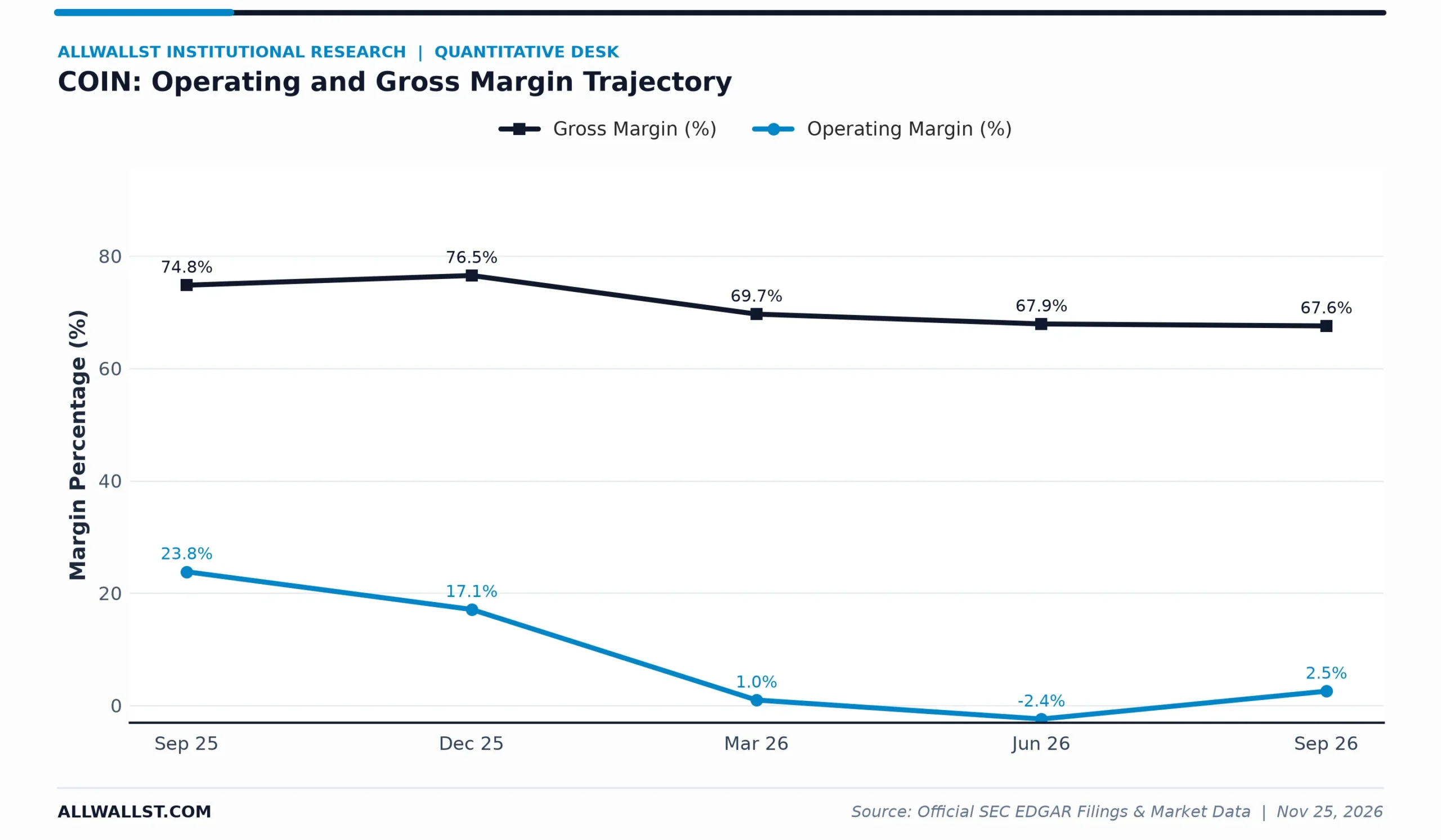
Furthermore, capital efficiency metrics show ongoing structural drag. Coinbase currently registers a Return on Invested Capital (ROIC) of just 0.04%, falling drastically short of its 8.50% Weighted Average Cost of Capital (WACC) hurdle rate. Despite maintaining an enviable 85.32% gross margin, heavy fixed operating costs and transaction fee compression have squeezed its operating margin down to a thin 0.12%. Management has deployed $790 million into share repurchases over the trailing twelve months, but until operating income re-accelerates, buybacks act primarily as a soak for executive compensation dilution rather than a catalyst for net share reduction.
Exchange Valuation Arbitrage and the Peer Gap
Evaluating Coinbase requires benchmarking its trading multiples against established traditional derivatives exchanges and emerging retail fintech platforms. While traditional venues generate predictable fee streams across interest rate and equity index products, Coinbase remains uniquely exposed to digital asset volatility and retail sentiment cycles.
| Company (Ticker) | Market Cap | Forward P/E | EV/EBITDA | Rev Growth (YoY) | Operating Margin | FCF Yield |
|---|---|---|---|---|---|---|
| Coinbase Global (COIN) | $27.1B | 42.7x | 92.7x | -34.20% | 0.12% | 13.59% |
| Robinhood Markets (HOOD) | $59.1B | 19.2x | N/A | 11.8% | 45.7% | N/A |
| CME Group (CME) | $110.7B | 23.3x | 22.7x | 13.0% | 66.2% | 2.76% |
| Intercontinental Exchange (ICE) | $97.7B | 19.6x | 17.3x | 14.7% | 53.2% | 0.31% |
The valuation disconnect across the sector is stark. Coinbase trades at a demanding forward price to earnings ratio of 42.7x and an enterprise value to EBITDA multiple of 92.7x. By comparison, Robinhood Markets (HOOD) trades at 19.2x forward earnings while generating a robust 45.7% operating margin and 11.8% top-line growth. Legacy financial infrastructure anchors like CME Group (CME) and Intercontinental Exchange (ICE) command operating margins above 50% while trading at reasonable forward earnings multiples of 23.3x and 19.6x respectively.
Market participants are effectively pricing Coinbase as a high-duration option on crypto ecosystem expansion. Investors are paying a premium multiple for COIN’s $8.82 billion total cash stack and dominant institutional custody presence, accepting negative net profit margins of -12.89% during industry lulls in anticipation of exponential fee expansion during market bull runs.
Options Derivatives Plumbing and Tactical Setup
Turning to derivatives market structure reveals how options market makers are positioned ahead of upcoming expirations. Options market plumbing provides essential mechanics for understanding near-term price floors and caps:
- Max Pain Strike ($111.00): The Max Pain level represents the exact strike price where the highest cumulative dollar value of call and put options expire completely worthless. With COIN spot trading around $102.34, spot sits +8.46% below the $111.00 Max Pain anchor, creating a slight upward gravitational pull into monthly option expiration as options dealers hedge their inventory.
- Primary Put Support Wall ($100.00): The $100.00 strike holds major downside open interest with 4,743 contracts. A Put Wall functions as an institutional floor. As spot price approaches this level, options dealers who sold these puts are forced to buy underlying stock to maintain delta neutrality, creating a mechanical bid. A secondary structural put floor rests deeper at the $80.00 strike (3,308 contracts).
- Primary Call Resistance Wall ($114.00): On the upside, heavy call open interest at $114.00 (7,432 contracts) acts as a formidable ceiling. Option sellers defend this strike by shorting shares as price surges, capping immediate momentum unless shattered by high trading volume.
- Implied Volatility and Expected Range: At an At-The-Money (ATM) Implied Volatility of 81.47%, the options market prices in a deterministic 30-day expected move of +/-$23.91 (or +/-23.36%), reflecting wide tail-risk expectations.
We previously audited Coinbase on November 2, 2026, issuing a HOLD rating at $137.83 (“Binance’s Misfortune and the Coinbase Valuation Riddle”). Since that call, shares have retraced down to $102.34, testing key technical support while fundamental parameters re-align with our quantitative framework.
A bull breakout thesis would require revenue growth to reverse its -34.20% YoY decline and push spot decisively past the $114.00 Call Wall toward $111.00 Max Pain, unlocking operating leverage across COIN’s 85.32% gross margin. Conversely, a bear breakdown below the $100.00 Put Wall toward $80.00 would be triggered if weak trading volumes drag ROIC further below the 8.50% WACC threshold while SBC dilution continues to eat into equity value.
Investment Committee Steelman Dissent: Bulls argue that Coinbase’s legal victory, $8.82 billion cash reserve, and 10.49% real ex-SBC FCF yield position the exchange as an indispensable tollbooth for institutional crypto adoption, rendering short-term margin compression irrelevant. Bears counter that a 42.7x forward P/E and 92.7x EV/EBITDA are unsustainably expensive for a business suffering a -34.20% YoY revenue contraction where stock-based compensation consumes 59.6% of operating cash flow.
AllWallSt Investment Verdict: HOLD (Reiterate HOLD)
Coinbase Global, Inc. (COIN)
Investigative Reporting & Public Record Sourcing: Dispatches published under Word on Wall St constitute financial news reporting, investigative journalism, and market commentary on matters of public and economic interest. Information is synthesized from publicly available regulatory filings (including SEC Form 8-K, Form 10-K, and Form 10-Q disclosures), official corporate press communications, verified news reports, and discussions with institutional market participants.
Presumption of Innocence & Unadjudicated Allegations: Any references to executive conduct, personal relationships, workplace misconduct, whistleblower claims, espionage inquiries, internal governance reviews, or government investigations represent reported allegations and active inquiries as of the publication date. They do not constitute formal judicial determinations, legal verdicts, or findings of guilt, civil liability, or statutory wrongdoing unless expressly identified as adjudicated final court judgments.
Protected Editorial Commentary & Non-Investment Counsel: All quantitative scenario analyses, key-person risk haircuts, forward valuation estimates, dealer gamma pinning levels, and investment conviction ratings reflect protected analytical opinion, editorial commentary, and financial modeling under the First Amendment. Nothing herein constitutes legal counsel, personal tax advice, or individualized investment advice. AllWallSt and its contributors assume no liability for trading, investment, or commercial decisions taken on the basis of this report.
Sources & References
- Official SEC Form 10-K Annual Report (Filed 2026-02-12)
- SEC Form 8-K Primary Filing Body (2026-09-02)
- Coinbase Global, Inc. Investor Relations Portal
- SEC Form 8-K Filing (Item 5.02 Board Disclosure, Oct 2, 2026)
- SEC Form 10-Q Quarterly Report (Period Ended Sept 30, 2026)
Regulatory Disclaimer & Editorial Terms
This publication is provided strictly for educational and informational purposes by AllWallSt. Nothing contained herein constitutes investment, legal, or tax advice. Opinions expressed reflect the analytical judgment of AllWallSt as of November 25, 2026, and are subject to change without notice. Financial figures, options flows, and regulatory disclosures are derived from primary SEC EDGAR filings and verified exchange feeds. Past performance is no guarantee of future returns. Readers should conduct independent due diligence before making capital allocation decisions.