
Most distress columns in biotechnology read like post-mortems of convertible debt maturities. A clinical-stage drug developer runs low on working capital, its stock drops below the conversion price, and hedge funds begin circling the corporate balance sheet like impatient buzzards.
CRISPR Therapeutics AG (CRSP) is not in that kind of trouble. In fact, if you evaluate the Swiss-headquartered gene-editing pioneer strictly as a credit risk, the right side of the balance sheet looks unusually plush. The company holds $2.27 billion in cash, cash equivalents, and marketable securities against total debt and long-term liabilities of roughly $779.8 million, leaving a comfortable net cash cushion of approximately $1.49 billion.
Yet the equity trades at $42.63, roughly 50% below where it changed hands five years ago. Wall Street is currently struggling with a classic duration puzzle: what do you pay for a company that has proved its underlying biology, secured landmark regulatory approvals for Casgevy, and maintains years of liquidity, but burns cash in a world where the risk-free US 10-Year Treasury yield pays 4.94%?
The Right Side of the Ledger and the Cost of Capital
In corporate credit, distress is defined by the inability to service contractual obligations. By that yardstick, CRISPR Therapeutics is in no danger of defaulting on anything. The company has zero pressing maturities that threaten its survival, no private credit unitranche lenders imposing punitive covenants, and no Payment-in-Kind interest notes silently swelling its principal.
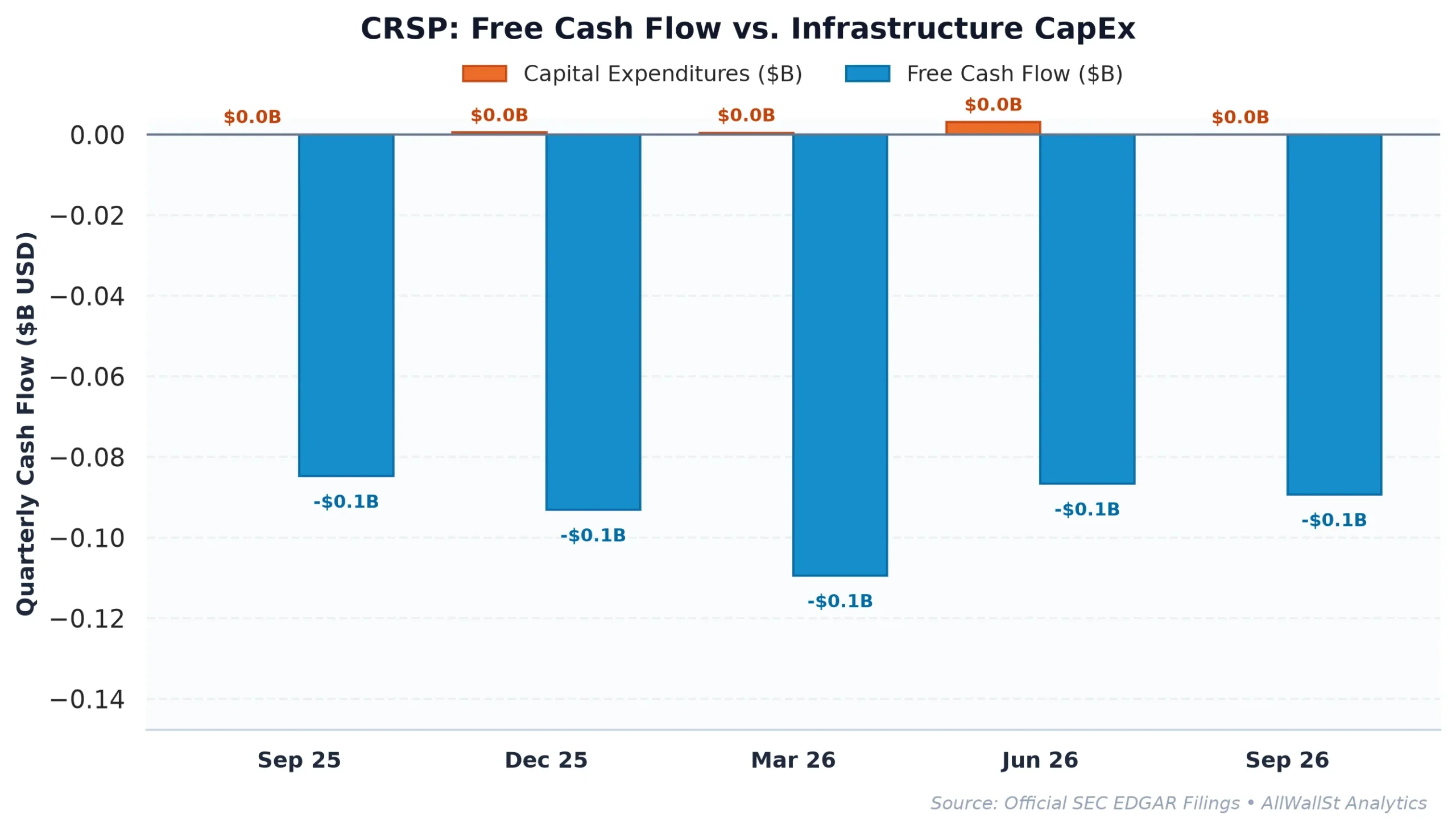
The distress here is purely economic rather than legal. It is the steady, arithmetic friction of negative free cash flow running headlong into an elevated cost of capital. Over the trailing twelve months, the company generated -$376.7 million in operational free cash flow, translating to an FCF yield of -9.11%.
When benchmark sovereign debt yielded near zero, an operating loss of several hundred million dollars felt like a noble down payment on medical history. Today, with the 10-Year Treasury benchmark anchored at 4.94%, holding an asset that consumes capital produces an Equity Risk Premium spread of negative 14.05%. Every dollar spent in clinical development carries an explicit opportunity cost.
Furthermore, reported cash flow understates the true economic burden on equity holders. Adding back $72.5 million in stock-based compensation from the past year pushes real economic cash burn toward -$450 million. The company is not facing a debt restructuring, but its equity continues to absorb the dilutive weight of continuous clinical trials.
The revenue line reflects the feast-or-famine reality of biotech partnerships. In FY2022, top-line revenue came in at a modest $436,000 before surging to $370.0 million in FY2023 on milestone payments from collaboration partner Vertex Pharmaceuticals. By FY2024, revenue receded to $35.0 million, and FY2025 recorded negligible revenue alongside an operating loss of -$568.3 million. Casgevy commercialization is gaining operational momentum, but clinical-stage manufacturing and complex hospital site accreditations mean commercial revenue scales slowly.
Pipeline Momentum Against the Clinical Cash Burn
The scientific engine itself is not idling. Earlier this month, trial updates across the portfolio highlighted active momentum in both autoimmune and cardiovascular indications. The company’s ongoing Phase 1/2 trial for CTX340 in hypertension (NCT07758634) and its autoimmune trial evaluating CTX112 in relapsed hematologic conditions (NCT07549698) represent attempts to move gene editing beyond rare monogenic diseases into massive addressable markets.
Meanwhile, long-term follow-up studies for its oncology CAR T candidates (NCT06208878) continue to demonstrate durability. The recent clinical data readouts for CTX310 and Zugo-cel have triggered speculative trading interest, but Phase 1 and Phase 2 assets carry a high probability of technical attrition before ever generating commercial revenue.
Recent regulatory filings also point to governance housekeeping. A Form 8-K filed on October 19, 2026, under Item 5.02 detailed executive transitions and consulting arrangements, following the approval of the amended 2026 Stock Option and Incentive Plan disclosed in its June meeting filings. The corporate machinery is functioning normally, but moving multiple candidate programs through mid-stage human trials requires hundreds of millions in annual research spending.
With $2.27 billion in total cash, the balance sheet provides at least four to five years of operational runway at current burn rates. Credit desks do not fear a liquidity event. Instead, equity investors are forced to calculate whether terminal cash flows from this pipeline will ever clear the hurdle rate demanded by a higher-for-longer macroeconomic backdrop.
Sector Valuation and the Cash Generation Gulf
To understand why the market is treating CRISPR Therapeutics with cautious neutrality, one must look at how institutional capital allocates across the broader healthcare complex.
| Company (Ticker) | Market Cap | Forward P/E | EV/EBITDA | Rev Growth (YoY) | Operating Margin | FCF Yield |
|---|---|---|---|---|---|---|
| CRISPR Therapeutics AG (CRSP) | $4.1B | N/A | N/A | 1325.10% | -2058.55% | -9.11% |
| Eli Lilly and Company (LLY) | $1.21T | 26.7x | 26.8x | 38.6% | 51.3% | 0.77% |
| UnitedHealth Group (UNH) | $299.3B | 14.2x | 12.4x | -0.4% | 5.9% | 8.85% |
| Johnson & Johnson (JNJ) | $651.7B | 23.3x | 19.7x | 5.9% | 26.6% | 2.84% |
The peer table highlights a stark institutional divide. Mature healthcare giants like Eli Lilly and Johnson & Johnson trade on traditional earnings multiples, supported by operating margins ranging from 26.6% to 51.3%. UnitedHealth offers an 8.85% Free Cash Flow yield, providing immediate cash returns that exceed the sovereign hurdle rate.
CRISPR Therapeutics, carrying an enterprise value of $2.30 billion and a market capitalization of $4.1 billion, trades at 91.4 times enterprise value to revenue. That revenue figure swings wildly depending on when collaboration milestones are recognized, resulting in a headline year-over-year revenue growth figure of 1,325% off an artificially small prior-year base.
The company possesses negligible gravitational pull in passive equity benchmarks like the S&P 500, meaning its price is driven almost entirely by active, idiosyncratic biotech specialists. Those specialists recognize that owning the equity today means paying a Price-to-Book multiple of 2.51x for an enterprise that will consume capital for the foreseeable future.
Derivatives Plumbing, Valuation Boundaries, and Verdict
Options market positioning reveals how institutional market makers are currently hedging this balance sheet standoff. At the current share price of $42.63, the options market is tightly pinned around a Max Pain strike of $43.00.
Max Pain represents the price point where the largest cumulative dollar volume of option contracts expires worthless. With spot price sitting less than 1% below that magnet level, dealer gamma hedging creates natural friction against large trending moves into the upcoming weekly expiration.
The overall Put/Call Open Interest ratio stands at 0.48, reflecting a heavy concentration of speculative call buying among retail and growth-oriented hedge funds. However, substantial Call Walls at $45.00 and $50.00 represent firm structural ceilings. Option sellers defending those strikes provide mechanical resistance, while Put Walls at $40.00 and $41.00 establish a supportive floor where delta-hedging bids tend to cushion selloffs.
Implied volatility sits at 50.99%, establishing a deterministic 30-day expected price range of plus or minus $6.23, or roughly 14.62% in either direction. The derivatives surface indicates that while the balance sheet protects the company from catastrophic downside, overhead call supply caps unbridled optimism.
Investment Committee Steelman Dissent: If commercial adoption of Casgevy accelerates materially faster than expected in foreign jurisdictions or upcoming clinical readouts for CTX310 demonstrate definitive blockbuster efficacy, CRISPR Therapeutics could experience an aggressive valuation re-rating that forces dealer call unwinds above the $50 resistance band. Conversely, sustained macroeconomic pressure and clinical trial delays could steadily bleed the company’s net cash cushion, exposing equity holders to protracted multiple compression.
With a massive cash runway guaranteeing survival but ongoing cash burn limiting near-term equity upside in an elevated interest rate regime, capital discipline warrants patience.
AllWallSt Investment Verdict: HOLD
CRISPR Therapeutics AG (CRSP)
Sources & References
- Official SEC Form 10-K Annual Report (Filed 2026-02-12)
- Official SEC Form 10-Q Quarterly Report (Filed 2026-11-02)
- SEC Form 8-K Primary Filing Body (2026-10-19)
- SEC Form 8-K Primary Filing Body (2026-06-04)
- SEC SC 13D/A Beneficial Ownership Disclosure (2021-02-16)
- SEC DEF 14A Proxy / M&A Filing (2026-04-21)
-
Official SEC EDGAR Filings & Disclosures: CRISPR Therapeutics AG (CIK: 0001674416)
- Corporate Investor Relations Portal: CRISPR Therapeutics AG Investor Relations
- Form 10-Q Quarterly Report for the Period Ended September 30, 2026 (Filed November 2, 2026)
- Form 8-K Material Event Disclosures (Filed October 19, 2026 and June 4, 2026)
- US National Library of Medicine Clinical Trials Registry (NCT07758634, NCT07549698, NCT06208878)
Regulatory Disclaimer: AllWallSt publishes independent financial journalism, market commentary, and balance-sheet forensic analysis for educational and institutional research purposes only. This publication does not constitute an offer, solicitation, or recommendation to buy, hold, or sell any security, bond, derivative, or investment vehicle. Past performance is no guarantee of future operational returns.