
If you are the CEO of a major technology company in 2026, you generally have two choices. You can spend fifty billion dollars attempting to design your own proprietary silicon, or you can go on the record telling the New York Times that NVIDIA Corporation (NVDA) Chief Executive Jensen Huang is a visionary hero who should probably be left alone by the Department of Justice.
Lately, the industry has chosen the latter. A unified front of Silicon Valley leaders has emerged to support Huang amidst intensifying regulatory scrutiny and whispers of an executive transition. This is not merely a gesture of professional courtesy. It is a structural necessity. When a single company provides the entire computing substrate for the global economy, the founder is no longer just a manager: he is a systemic risk. The market calls this an alliance, but in capital terms, it looks more like a mutual assured destruction pact. If the NVIDIA ecosystem fractures, the AI roadmaps of every major hyperscaler go up in smoke.
The Software Lock-in and the Hardware Moat
The mainstream narrative focuses on the H200s and Blackwell chips, the physical objects that NVIDIA Corporation sells for the price of a small house. However, the real story is the alliance lock-in. By integrating software, networking, and silicon into a single, high-friction environment, the company has created a dependency that makes switching costs look more like a corporate exit tax.
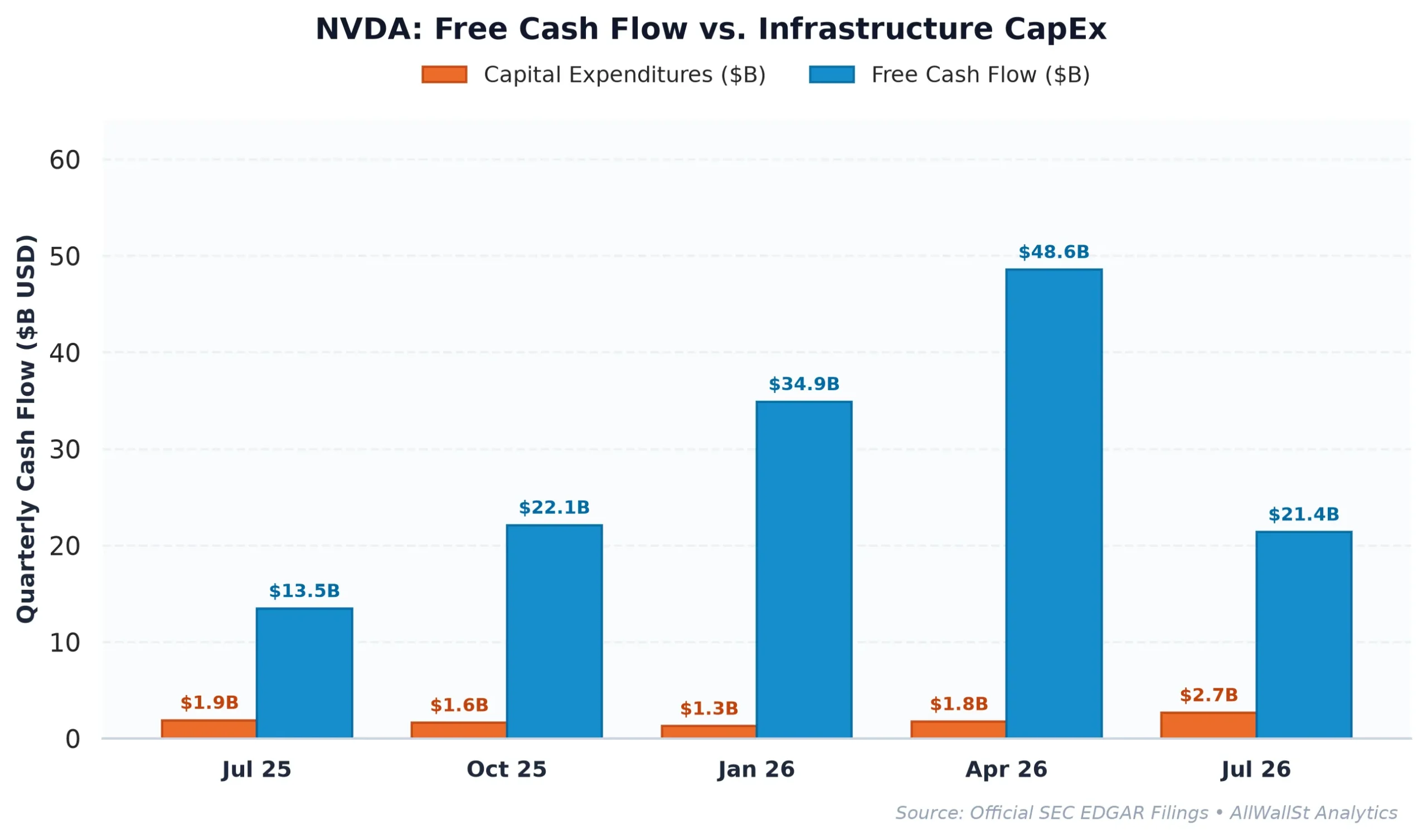
This ecosystem dependency is what allows the company to maintain a 74.67% gross margin while spending $92.55 billion on capital expenditures. For context, that CapEx intensity represents over 30% of revenue. In any other industry, spending 30% of your top line just to keep the lights on would be viewed as a desperate struggle for survival. At NVIDIA, it is viewed as a victory lap. The company is effectively building a moat out of pure capital, outspending competitors like Advanced Micro Devices (AMD) to ensure that the next generation of compute is already spoken for before it even leaves the fab.
The Valuation Paradox of 2026
If you look at a standard Bloomberg terminal, NVIDIA Corporation looks like a value stock. It is trading at 10.9x forward earnings. Compare that to AMD at 31.3x or Broadcom (AVGO) at 17.7x, and you might conclude that the market has collectively lost its mind. How can the fastest-growing company in history, with a Rule of 40 score of 119.7, trade at a discount to its slower-moving peers?
The answer lies in the quality of the cash. While the accounting earnings are spectacular, the Free Cash Flow (FCF) yield is a modest 1.00%. In a world where the US 10-Year Treasury yield is sitting at 5.00%, an equity investor is accepting a negative 4.00% spread for the privilege of owning NVIDIA. You are essentially paying Uncle Sam a 400 basis point premium to take on the risk of a semiconductor cycle.
Furthermore, the share repurchase program is doing a lot of heavy lifting. The company spent $40.09 billion on buybacks over the last year, but when you net out the $6.39 billion in stock-based compensation, the real economic return to shareholders is thinner than the marketing materials suggest. The buybacks are largely serving to neutralize the dilution required to keep the world’s best engineers from defecting to a startup.
Market Plumbing and the $175 Magnet
While the fundamental analysts debate the terminal value of AI, the options market is busy doing something much more literal. The current Max Pain strike for NVIDIA Corporation is $175.00. With the stock trading at $173.73, the price is effectively pinned by dealer gamma.
The Put/Call Open Interest ratio stands at 0.68, which indicates a healthy level of speculative call buying, but the “Call Walls” at $180 and $190 are formidable. For the stock to break out of this range, it would require a catalyst strong enough to force dealers to chase the move. For now, the market seems content to let the stock oscillate around its current level, waiting to see if the “alliance” of tech CEOs can actually ward off the regulatory hawks.
We are also seeing a significant divergence between Wall Street’s career-risk consensus and the cold reality of the balance sheet. Sell-side analysts have a “Strong Buy” on the stock because it represents 7.6% of the S&P 500. If you are a fund manager and you don’t own NVIDIA, and it goes up, you lose your job. If you own it and it goes down, you just had a “bad quarter” along with everyone else. This benchmark gravity creates a floor for the stock that has nothing to do with discounted cash flows and everything to do with institutional self-preservation.
The Limits of Indispensability
The support for Jensen Huang is a double-edged sword. On one hand, it confirms the moat. On the other, it highlights the fragility of the bull case. If the entire investment thesis relies on one man’s ability to maintain a diplomatic truce between regulators and hyperscalers, the “key man risk” is effectively off the charts.
NVIDIA is currently earning more in net income ($192.88 billion) than most countries produce in GDP. Its Return on Invested Capital (ROIC) of 76% is a miracle of modern capitalism. But miracles are rarely permanent. At some point, the massive CapEx being deployed by NVIDIA’s customers must generate its own return on investment, or the buying will stop. Until we see that second-order proof of AI profitability, the stock remains a captive of its own success.
AllWallSt Investment Verdict: HOLD
NVIDIA Corporation (NVDA)
Trailing P/E
Marcus Wolfe Screen
Leverage Profile
30D Channel
Dealer Gamma Pinning & Max Pain Alignment (NVDA)
🎯 Max Pain: $175.00
Spot $173.73
Ceiling $190C Resistance
MODERATE WATCHLIST (1 flag): Inventory growth outpaced COGS growth by >15%, signaling potential inventory bloat or pending margin compression.
Fortress Balance Sheet (Net Cash Position; zero net refinancing distress).
Negative yield spread (-4.00% vs 5.00% Treasury); equity requires robust multiple expansion or growth.
Max Pain: $175.00 (+0.73%) | P/C Ratio: 0.68 | 30D Channel: $148.94 – $198.52. Dealer gamma bounded between $165 Put Wall and $190 Call Wall.
NVDA commands a massive ~7.6% S&P 500 benchmark footprint. Wall Street sell-side consensus reflects structural career-risk defense: institutional funds face severe benchmark tracking penalties for underweighting mega-cap heavyweights, forcing mandatory allocations regardless of current Free Cash Flow yield.
Accumulation Deferred (Await Pullback toward $161.70 – $168.30 Support Pinning)
Sustained weekly close below $165.00 (Put Wall) or acceleration in margin compression.
Sources & References
- Official SEC Form 10-K Annual Report (Filed 2026-02-25)
- Official SEC Form 10-Q Quarterly Report (Filed 2026-08-26)
- NVIDIA Corporation Investor Relations: https://www.nvidia.com/en-us/about-nvidia/investor-relations/
- SEC EDGAR Filings (CIK 0001045810): https://www.sec.gov/edgar/browse/?CIK=0001045810
- Primary Source: Form 10-Q filed August 26, 2026.
- Primary Source: Form 8-K filed September 3, 2026.
Disclaimer: This report is for informational purposes only and does not constitute investment advice. AllWallSt and its affiliates may hold positions in the securities mentioned. Investing in equities involves substantial risk, including the loss of principal. Past performance is not indicative of future results.