
There is a recurring pattern in modern finance where an upstart brokerage invents a delightful interface, convinces millions of retail traders to treat complex financial derivatives like a mobile video game, and then faces the sobering reality of becoming a regulated corporate institution. Robinhood Markets, Inc. (HOOD) spent its early years learning that zero-commission trading is not free, payment for order flow attracts congressional subpoenas, and meme-stock frenzies require vast clearinghouse deposits. Today, the stock trades at $67.37, reflecting a dramatic recovery from its post-IPO trough, yet the narrative tension has merely shifted to a higher altitude.
On the tape over the past 48 hours, market sentiment resembles a split decision among heavyweight allocators. Institutional filings show funds like Fisher Investments trimming equity exposure while rival asset managers pile into the shares. Jim Cramer declared the equity run stretched too thin, which retail message boards immediately celebrated as a contrarian buy signal. At the same time, prediction market operator Kalshi warned that aggressive regulatory intervention in New York could threaten event-contract trading models nationwide, casting an uncomfortable shadow over the next wave of speculative retail engagement. The Commodity Futures Trading Commission has simultaneously advanced proposed regulations covering crypto asset markets under Docket 2026-20888, reminding investors that regulatory perimeter risks never truly disappear.
The Balance Sheet Pivot and Zero-Coupon Financial Engineering
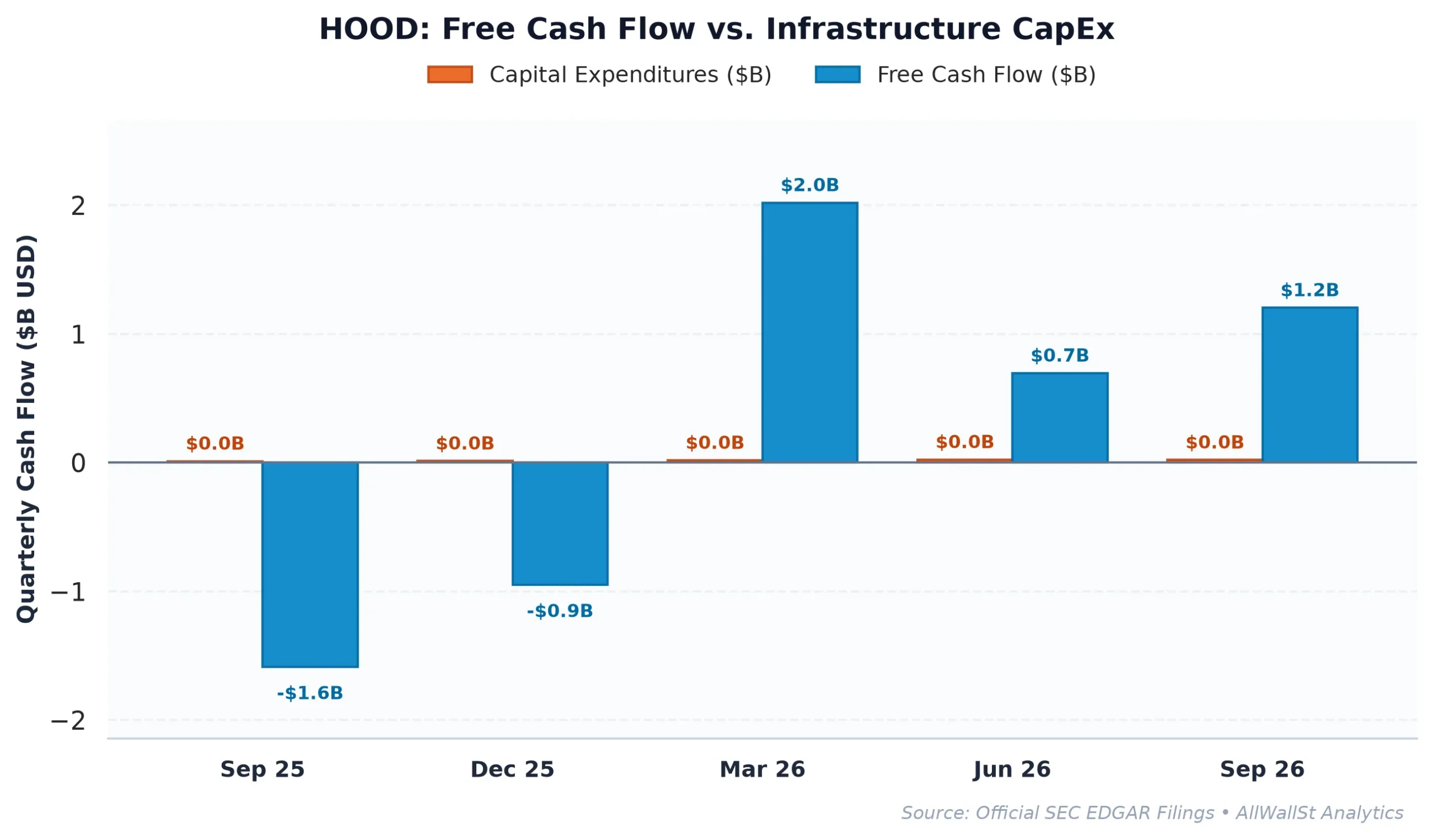
If you want to understand how Robinhood survived the deflation of the 2021 retail bubble, you have to look past the day-trading chatter and inspect its operating plumbing. Back in FY2022, Robinhood was an operational furnace, incinerating capital with an operating loss of -$966.0M on revenue of $1.36B, accompanied by negative free cash flow of -$909.0M. Executive compensation was heavily subsidized through equity dilution, with stock-based compensation devouring $654.0M in a single year. By FY2025, operating discipline took hold, generating $2.09B in operating income on $4.47B in revenue as operating margins expanded to an impressive 46.8%.
Over the trailing twelve months, total revenue reached $5.08B with GAAP net income standing at $1.98B, demonstrating that the platform can generate cash when interest rates remain elevated and market volatility stays buoyant. Trailing free cash flow came in at $2.97B, though an honest appraisal requires subtracting $0.30B in annual stock-based compensation to arrive at real economic cash flow of $2.67B. That represents a real free cash flow yield of 4.39%, which sits slightly below the prevailing 4.92% yield on the 10-Year US Treasury benchmark. When an equity risk premium is essentially flat against risk-free sovereign debt, shareholders must rely on sustained asset compounding rather than a margin of safety.
The corporate treasury has also engaged in sophisticated liability engineering. In June 2026, Robinhood completed an offering of $2.2 billion in zero-coupon convertible senior notes due in 2029 under Form 8-K disclosures. To avoid diluting equity holders while borrowing free cash, the firm deployed $290 million of the proceeds to repurchase outstanding Class A common stock and paid $123.2 million to enter into capped call transactions designed to neutralize conversion dilution up to an elevated threshold. Management noted in official filings that the deal provides strategic flexibility to fund product expansion. With $24.83B in total cash reserves against $22.55B in custodial and operational liabilities, Robinhood maintains a clean net cash surplus of -$2.28B, giving it substantial insulation against liquidity shocks.
Sizing the Platform Against Traditional and Crypto Rivals
Robinhood operates in an unusual competitive twilight zone. It is neither an old-guard custodial giant like Charles Schwab nor a pure-play digital token exchange like Coinbase Global. It is a consumer financial supermarket catering to an audience that trades equity options before breakfast and fractional meme coins after dinner.
| Company (Ticker) | Market Cap | Forward P/E | EV/EBITDA | Rev Growth (YoY) | Operating Margin | FCF Yield |
|---|---|---|---|---|---|---|
| Robinhood Markets (HOOD) | $60.7B | 19.7x | 26.8x | 11.80% | 45.65% | 4.90% |
| Coinbase Global (COIN) | $28.8B | 45.3x | 99.0x | -34.2% | 0.1% | 12.78% |
| Charles Schwab (SCHW) | $159.4B | 11.8x | N/A | 16.9% | 51.1% | N/A |
| Interactive Brokers Gr (IBKR) | $130.3B | 23.1x | N/A | 13.5% | 77.6% | N/A |
The peer matrix illustrates why Wall Street consensus is conflicted. At a forward price-to-earnings multiple of 19.7x, Robinhood trades at a noticeable discount to Interactive Brokers at 23.1x and Coinbase at 45.3x, though at a steep premium to Charles Schwab at 11.8x. However, valuation multiples for retail brokerages are heavily path-dependent. Charles Schwab generates an operating margin of 51.1% by managing massive institutional and wealth advisory balances that rarely churn. Interactive Brokers delivers an extraordinary 77.6% operating margin because its sophisticated automated infrastructure serves algorithmic traders and family offices with negligible customer acquisition costs.
Robinhood’s trailing operating margin of 45.65% and return on invested capital of 26.71% show that its platform monetization has improved dramatically. Its Rule of 40 score reaches 70.2%, combining 11.80% top-line revenue growth with a 58.4% free cash flow margin. Yet, Robinhood remains heavily exposed to transaction velocity. When retail animal spirits cool, payment for order flow drops, margin borrowing balances contract, and crypto trading fees compress. Coinbase suffered a -34.2% revenue contraction during its down cycle, providing a cautionary tale of what happens when retail speculative volumes evaporate.
Governance Footnotes and the Prediction Market Frontier
Corporate governance at Robinhood remains structured to insulate founders Vlad Tenev and Baiju Bhatt from outside proxy challenges. The dual-class equity structure concentrates voting power in high-vote shares, ensuring that strategic decisions remain firmly entrenched in the boardroom. While recent Item 5.02 Form 8-K filings reflect routine board refreshes rather than executive turmoil, institutional investors routinely apply a modest governance discount to terminal valuation multiples when public common equity possesses diluted proxy influence.
The newer strategic uncertainty centers on prediction markets and event contracts. As retail platforms rush to monetize political elections, macroeconomic data releases, and cultural outcomes, state regulators and federal agencies are pushing back. The recent industry warnings regarding New York regulatory scrutiny highlight that state gaming commissions and national regulators do not always agree on where financial hedging ends and unlicensed sports wagering begins. If legal challenges restrict event-based derivative contracts, one of the most lucrative engagement funnels could face sudden compliance costs and operational ring-fencing.
Furthermore, Robinhood’s deposit base exhibits high sensitivity to short-term interest rates. A substantial portion of its net interest revenues stems from cash sweeps, securities lending, and margin loans. If the macroeconomic rate environment softens, net interest income will naturally decline unless retail transaction volumes accelerate aggressively to offset the spread compression.
Options Plumbing, Volatility Bands, and the Verdict
Turning to derivatives market structure, options positioning paints a clear picture of speculative crowding. With spot equity trading at $67.37, the Put/Call open interest ratio stands at an ultra-bullish 0.54, indicating that market participants have loaded up heavily on upside call contracts. When call buying becomes this lopsided, options market makers must buy underlying stock to hedge their positive delta exposure. If upward momentum stalls, however, the mechanical decay of out-of-the-money call premiums forces dealers to unwind their equity hedges, creating an air pocket beneath the price.
The options ledger reveals heavy Call Walls at the $75.00, $76.00, and $80.00 strikes, which represent formidable structural resistance where dealers will actively supply shares. Conversely, primary Put Support rests down at $65.00, followed by deeper institutional safety nets at $60.00 and $50.00. The Max Pain strike, the price level where the maximum dollar volume of option contracts expires completely worthless, sits slightly above spot at $71.00. At-the-money implied volatility sits at an elevated 75.30%, establishing a deterministic 30-day expected price move of +$14.55 or -$14.55 (a 21.59% dispersion band).
AllWallSt Institutional Safe Harbor & Regulatory Notice: This analysis evaluates public corporate filings, exchange-traded derivatives open interest, and regulatory agency announcements. Probes, state warnings, and proposed rules discussed herein represent active administrative proceedings or industry commentaries and do not constitute formal judicial findings of liability.
Robinhood has successfully executed an impressive operational turnaround, pivoting from a volatile cash-burner into a profitable, high-margin financial supermarket. However, with its 4.90% free cash flow yield failing to offer a risk premium over the 4.92% sovereign bond rate, and dealer gamma positioning leaving the equity vulnerable to long-liquidation air pockets near the $75 Call Wall, initiating new exposure at current levels lacks an adequate margin of safety.
Investment Committee Steelman Dissent: If retail speculative momentum triggers an unexpected explosion in crypto and event-contract trading volumes, transaction revenue could easily shatter consensus forecasts. Under that scenario, aggressive dealer short-covering above the $75 Call Wall could rapidly propel the stock toward the upper bound of its 30-day dispersion envelope.
AllWallSt Investment Verdict: HOLD
Robinhood Markets, Inc. (HOOD)
Investigative Reporting & Public Record Sourcing: Dispatches published under Word on Wall St constitute financial news reporting, investigative journalism, and market commentary on matters of public and economic interest. Information is synthesized from publicly available regulatory filings (including SEC Form 8-K, Form 10-K, and Form 10-Q disclosures), official corporate press communications, verified news reports, and discussions with institutional market participants.
Presumption of Innocence & Unadjudicated Allegations: Any references to executive conduct, personal relationships, workplace misconduct, whistleblower claims, espionage inquiries, internal governance reviews, or government investigations represent reported allegations and active inquiries as of the publication date. They do not constitute formal judicial determinations, legal verdicts, or findings of guilt, civil liability, or statutory wrongdoing unless expressly identified as adjudicated final court judgments.
Protected Editorial Commentary & Non-Investment Counsel: All quantitative scenario analyses, key-person risk haircuts, forward valuation estimates, dealer gamma pinning levels, and investment conviction ratings reflect protected analytical opinion, editorial commentary, and financial modeling under the First Amendment. Nothing herein constitutes legal counsel, personal tax advice, or individualized investment advice. AllWallSt and its contributors assume no liability for trading, investment, or commercial decisions taken on the basis of this report.
Sources & References
- Official SEC Form 10-K Annual Report (Filed 2026-02-18)
- Official SEC Form 10-Q Quarterly Report (Filed 2026-10-28)
- SEC Form 8-K Exhibit 99.1 (Press Release / Earnings) (2026-06-25)
- SEC Form 8-K Primary Filing Body (2026-06-26)
-
Securities and Exchange Commission EDGAR Database: Robinhood Markets, Inc. Corporate Filings (CIK 0001783879)
- Robinhood Markets Investor Relations: Corporate Overview and Financial Reports
- Commodity Futures Trading Commission: Proposed Rule on Crypto Asset Markets (Docket 2026-20888)
- Form 8-K Definitive Agreement: Zero-Coupon Convertible Senior Notes Due 2029 (Filed June 25, 2026)
Disclaimer: This research dispatch is published strictly for institutional financial commentary and informational purposes. Nothing contained herein constitutes investment, legal, tax, or regulatory advice. All opinions reflect market conditions as of November 24, 2026.