
The fundamental tension of The Charles Schwab Corporation (SCHW) is that it spends a great deal of marketing effort pretending to be a friendly neighborhood brokerage while its balance sheet spends all its time being a massive, sophisticated bank. In the eyes of the retail investor, Schwab is a place where you buy index funds and occasionally check your retirement balance. In the eyes of the fixed-income market, Schwab is a giant pile of deposits that must be meticulously managed against a shifting yield curve.
For the better part of two years, the consensus narrative around the company was defined by a single, terrifying phrase: cash sorting. This is the process where customers realize their idle cash is earning 0.45 percent while a money market fund is paying 5 percent, leading them to move that money into higher-yielding vehicles. When customers sort their cash, Schwab has to find more expensive ways to fund its own investments, which makes the margins look less like a tech company and more like, well, a bank.
The current consensus, championed by the usual suspects on the financial wires, is that the sorting is over. The narrative suggests that the interest rate environment has stabilized, the “low-hanging fruit” of customer cash has already moved, and Schwab is now a coiled spring ready to expand its net interest margins. It is a lovely story of recovery and normalization. It is also a story that might be ignoring the gravity of the options market and the structural reality of being a $162 billion financial utility.
The $100 Magnet and the Gamma Wall
While the fundamental analysts talk about net interest revenue and asset gathering, the market plumbers are looking at a different set of numbers. The Charles Schwab Corporation currently trades near $94, but the options market has a very specific destination in mind. The Max Pain strike sits at $100.00, representing a 6.42 percent move from current levels.
In a world of balanced dealer gamma, this $100 level acts as a magnetic anchor. If the stock drifts toward it, dealers who are short those options have to buy the underlying stock to stay neutral, effectively pulling the price toward the point where the most options expire worthless. However, the path to $100 is not a clear runway. There is a primary call resistance wall at $105 and $110, suggesting that while the market is happy to see Schwab recover, institutional players are selling the upside to collect premium.
The 30-day expected move is a healthy plus or minus 7.83 percent. This implies that the market expects a volatility event, likely tied to the realization that even if cash sorting has slowed, the cost of funding for a bank of this scale remains structurally higher than it was during the era of free money.
Balance Sheet Gymnastics
The Charles Schwab Corporation (SCHW) carries a massive $96.36 billion in total cash against $75.78 billion in total debt. On paper, having $20.58 billion in net cash is an enviable position for almost any corporation. But for a financial institution, the quality of that cash is everything.
The company boasts an operating margin of 52.28 percent and a return on equity of 20.27 percent. These are elite numbers. They are the reason the stock commands a trailing P/E of nearly 17x while most regional banks are lucky to see double digits. The market is essentially paying a “trust premium” for the Schwab brand.
The risk to the consensus “recovery” thesis is that the market is treating Schwab like a growth stock when it is actually a sensitivity play on the 10-Year Treasury. With the 20+ Year Treasury (TLT) showing signs of life and yields fluctuating, the spread Schwab can earn on its massive deposit base is constantly being repriced. If the 10-Year yield stays elevated, the pressure on Schwab to pay more for its deposits does not simply vanish just because the initial “panic” of sorting is over.
The Verdict on Consensus
The loudest narrative today is that the worst is behind Schwab. And from a pure liquidity standpoint, that is probably true. The company survived a period of unprecedented interest rate volatility without breaking. But surviving is not the same as thriving in a way that justifies a 17x multiple in a 4.5 percent rate world.
The options structure suggests a drift toward $100, but the fundamental reality is that Schwab is now a mature, highly regulated bank that happens to have a very good website. The days of effortless margin expansion from zero-cost deposits are likely gone. What remains is a high-quality business that is currently being priced for a return to a golden age that the bond market has no interest in revisiting.
📊 AllWallSt Investment Verdict
| Company / Ticker | Rating | Word/Horizon |
|---|---|---|
| The Charles Schwab Corporation (SCHW) | HOLD | 12-18 Months |
Conviction rating derived from quantitative fundamental models, options open interest distribution, and primary SEC filing review.
The Charles Schwab Corporation (SCHW)
Trailing P/E
Marcus Wolfe Screen
Leverage Profile
30D Channel
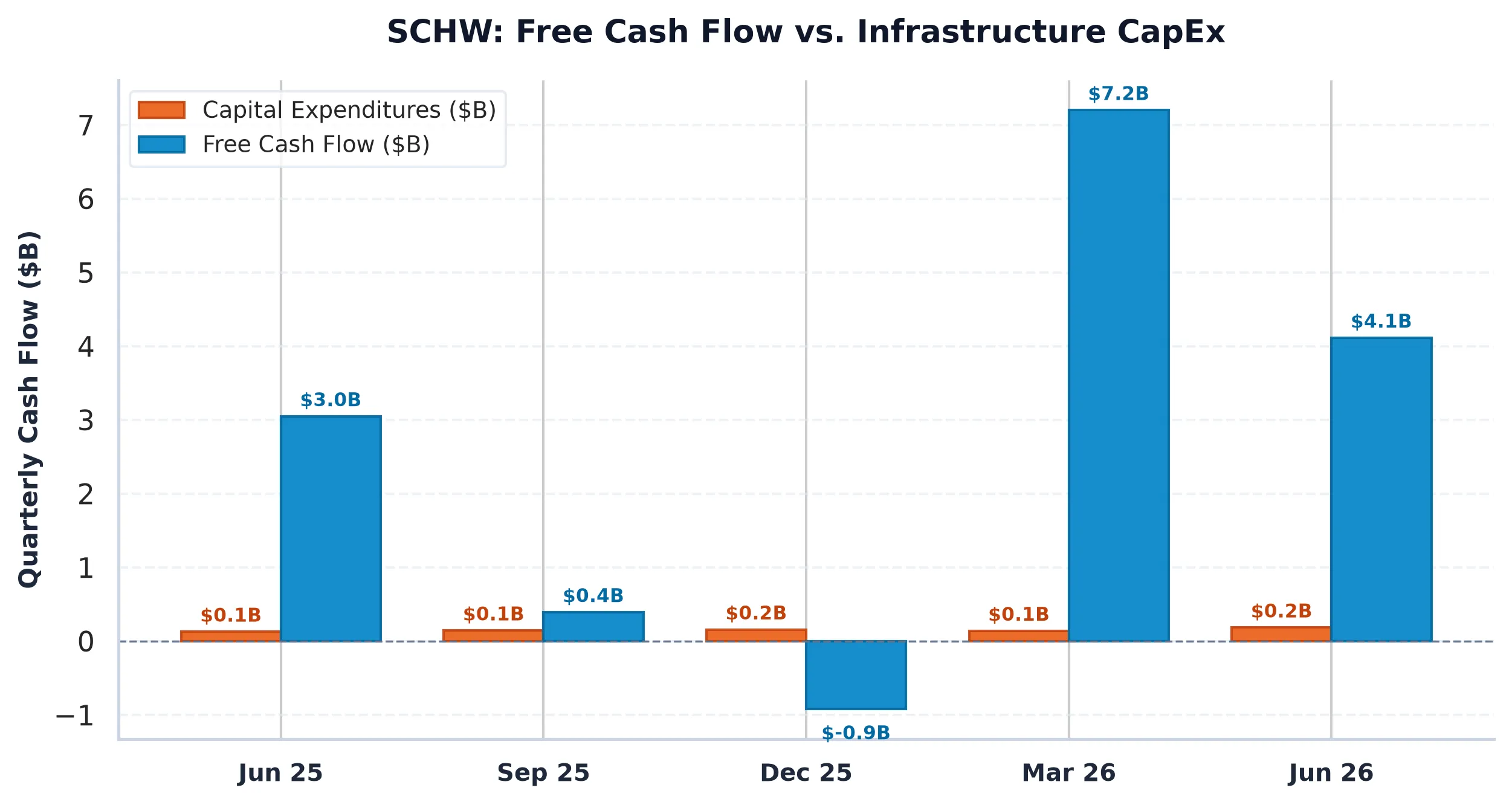
Pristine cash flow conversion (1.05x) and healthy accrual ratio (-0.09%). Zero accounting anomalies detected (LOW ANOMALY RISK).
Tier 1 Regulatory Capital & Liquidity Coverage Ratio (LCR) compliant; balance sheet governed by Basel III capital buffers.
Evaluated against 5.10% US 10-Yr Benchmark; bank net interest margins sensitive to yield curve slope (2s10s spread) and deposit beta.
Max Pain: $96.00 (+4.39%) | P/C Ratio: 0.82 | 30D Channel: $85.37 – $98.55.
$84.60 – $88.28 (-4% to -8% Pullback Accumulation)
Sustained weekly close below $82.76 (-10.0% structural stop) or fundamental cash flow deterioration.