
Selling The Future at Ninety-Four Times Earnings
Financial markets run on stories, but every few years someone remembers to check the plumbing. If you read the sell-side notes circulating through Wall Street this week, Snowflake Inc. (SNOW) is on the verge of another triumph. Oppenheimer and Morgan Stanley are previewing fiscal third-quarter product revenue upside, pointing to accelerating cloud workloads and the endless corporate appetite to feed data into artificial intelligence models. Hedge funds are split down the middle: regulatory filings show George Soros and Cathie Wood trimmed their exposure, while two dozen other institutions jumped in.
The story is seductive. Snowflake builds elegant software that lets enterprises store, organize, and query petabytes of information across Amazon Web Services, Microsoft Azure, and Google Cloud without getting locked into any single provider. Because modern generative AI models require massive troves of clean corporate data to do anything useful, Snowflake gets treated as an essential utility for the technological future.
The problem is what you have to pay for that future, and what you actually get in return. At $290.20 per share, Snowflake carries a market capitalization of $102.4 billion and an enterprise value of $98.96 billion. That prices the company at 94.4x forward earnings and an eye-watering 47.58x book value. Meanwhile, the benchmark US 10-Year Treasury yield hovers around 5.10%. When safe sovereign debt pays more than five percent with zero operational risk, paying nearly a hundred times earnings for a software business that has never posted an annual GAAP profit is an extraordinary act of faith.
How to Turn an Operating Loss Into Adjusted Cash Flow
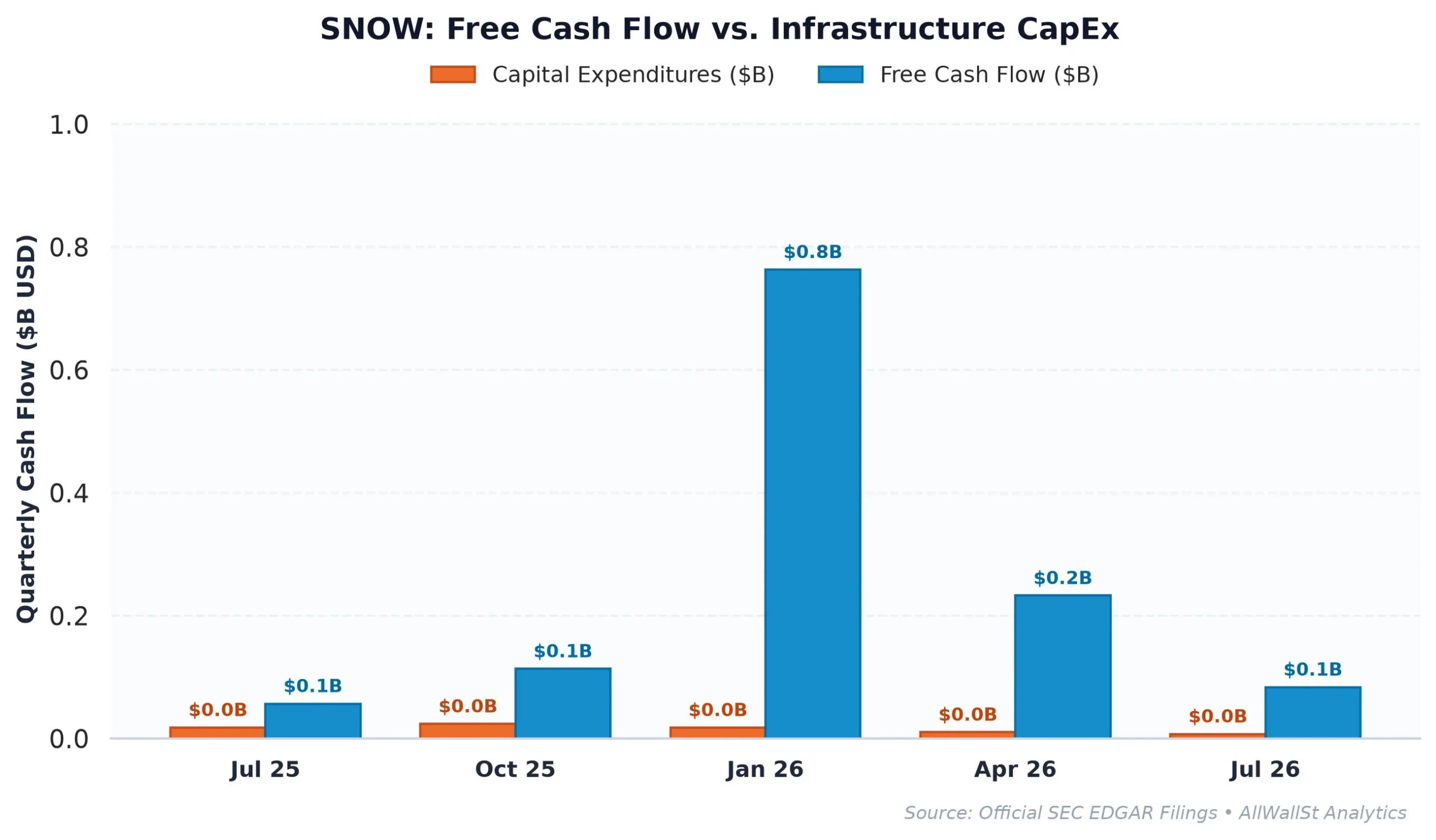
To understand the core tension in Snowflake’s financial engine, you have to look at how modern enterprise software companies define profitability. If you glance at Snowflake’s marketing decks, you will see a celebrated business printing robust cash. Over the trailing twelve months, Snowflake generated $5.43 billion in total revenue and reported $1.19 billion in Free Cash Flow, translating to an apparent Free Cash Flow yield of 1.17%.
That sounds respectable until you open the statement of cash flows and examine line items that management prefers you treat as academic trivia. Over that same trailing twelve-month stretch, Snowflake handed out $1.60 billion in Stock-Based Compensation (SBC). That single compensation expense consumed 127.6% of its operating cash flow.
In accounting textbooks, stock compensation is labeled a non-cash expense because no physical dollar leaves the corporate bank account on the day restricted stock units vest. In real corporate life, handing employees equity is very much an economic expense. If you do not issue shares, you have to pay them cash; if you do issue shares, you dilute existing owners. When you calculate real economic Free Cash Flow by subtracting stock-based compensation from reported cash flow, Snowflake did not generate $1.19 billion. It burned negative $410 million, yielding a negative 0.40% real cash flow return.
| Period | Revenue | Operating Income | Operating Margin | Free Cash Flow | SBC Expense |
|---|---|---|---|---|---|
| FY2023 | $2.07B | $-842.3M | -40.8% | $495.8M | $861.5M |
| FY2024 | $2.81B | $-1.09B | -39.0% | $750.2M | $1.17B |
| FY2025 | $3.63B | $-1.46B | -40.2% | $884.1M | $1.48B |
| FY2026 | $4.68B | $-1.44B | -30.6% | $1.12B | $1.60B |
The four-year trajectory laid out above tells an unmistakable story. Revenue expanded from $2.07 billion in FY2023 to $4.68 billion in FY2026, which is impressive commercial execution. Yet GAAP operating losses deepened from negative $842.3 million to negative $1.44 billion, while annual stock-based compensation almost doubled from $861.5 million to $1.60 billion.
Management attempts to neutralize this dilution by repurchasing shares, deploying $870 million into buybacks over the past year. But this buyback program does not actually shrink the share count to boost per-share intrinsic value. It merely siphons cash to soak up employee stock grants at ninety times forward earnings, functioning as an expensive corporate sterilizer.
Meanwhile, the capital structure is growing more complex. In October 2026, Snowflake filed Form 8-K disclosures outlining a private placement of $3.5 billion in 0.00% convertible senior notes, split between $1.3 billion due in 2029 and $2.2 billion due in 2031. Management earmarked $548.3 million of the proceeds to retire $261.8 million of its existing 2027 convertible notes in privately negotiated buybacks. Convertible debt offers cheap upfront cash, but it introduces prospective dilution or looming refinancing obligations down the road. With total debt now standing at $2.76 billion against $2.34 billion in cash, net debt sits at $420 million for a business sporting a trailing operating margin of negative 22.43%.
The Premium for Negative Operating Margins
Enterprise software multiples are not created equal. Investors often grant rich multiples to software franchises with sticky enterprise contracts, but those valuations are supposed to reflect rapid progression toward massive cash generation. When you stack Snowflake against its direct cloud and data infrastructure peers, the valuation premium becomes difficult to rationalize.
| Company (Ticker) | Market Cap | Forward P/E | EV/EBITDA | Rev Growth (YoY) | Operating Margin | FCF Yield |
|---|---|---|---|---|---|---|
| Snowflake (SNOW) | $102.4B | 94.4x | N/A | 35.10% | -22.43% | 1.17% |
| Palantir Technologies (PLTR) | $389.4B | 63.7x | 109.5x | 95.9% | 45.6% | 0.68% |
| Datadog (DDOG) | $63.6B | 55.3x | 331.3x | 35.2% | 2.4% | 1.68% |
| MongoDB (MDB) | $25.8B | 40.5x | N/M (>500x) | 30.5% | -0.5% | 2.17% |
Consider the structural divergence across this peer cohort. Palantir Technologies trades at an enterprise multiple that gives traditional value investors heartburn, but it delivers 95.9% revenue growth alongside a massive 45.6% GAAP operating margin. Datadog matches Snowflake’s 35% topline pace, yet operates with positive GAAP margins and trades at 55.3x forward earnings, roughly forty turns cheaper than Snowflake. MongoDB delivers 30.5% growth at 40.5x forward earnings while hovering near operating breakeven.
Snowflake commands the highest forward price-to-earnings multiple in the cohort at 94.4x, despite carrying the worst GAAP operating margin at negative 22.43%. For institutional index funds, Snowflake carries a moderate footprint, representing roughly 0.2% of standard large-cap benchmarks. Passive indexation creates steady mechanical demand, but active fund managers face a severe opportunity cost. Snowflake’s headline Free Cash Flow yield of 1.17% sits 3.93% below the risk-free 10-Year Treasury yield. When you factor in stock-based compensation, investors are accepting a negative real yield to own a company whose GAAP losses have hovered above a billion dollars annually for three consecutive years.
Governance disclosures also highlight the mounting cost of executive retention. In a July 2026 Form 8-K filing, Snowflake detailed terms surrounding substantial CEO performance equity grants. Retaining top enterprise software talent in Silicon Valley is undeniably expensive, but common shareholders are the ones footing the dilution bill while commercial litigation works through the background, including the Teachers’ Retirement System of the City of New York appeal before the Ninth Circuit (Docket 26-6773) and vendor claims in bankruptcy court (LaPuma v. Snowflake, Docket 26-03721).
Gamma Ceilings and the Cost of Capital Reality
Options market structure underscores the speculative optimism currently propping up the equity. Snowflake trades at $290.20, pinned right against its options Max Pain strike of $290.00, which represents the exact price level where the maximum dollar value of outstanding options contracts expires worthless for buyers.
The Put/Call open interest ratio sits at an aggressive 0.64. A ratio this low reveals that institutional and retail participants have piled heavily into speculative call options, anticipating an earnings breakout. In the options plumbing, market makers who sell these calls hedge their exposure by purchasing underlying common stock as the price rises.
Primary overhead call resistance sits at the $300, $320, and $350 strikes, creating a formidable Call Wall where options dealers must sell stock to neutralize their books if momentum stalls. Primary downside put support is clustered lower at $280 and $270. While headline at-the-money implied volatility registers at 93.19%, suggesting an expected 30-day move of plus or minus $77.54 (or 26.72%), wider bid-ask spreads during off-hours trading likely exaggerate this near-term implied swing. Nonetheless, the structural setup is fragile. When speculative call buying slows, dealer hedging flows reverse, transforming supportive buying bids into mechanical selling pressure.
Forty-one days ago, on October 9, 2026, we assigned a cautious HOLD on Snowflake when the stock changed hands at $368.89. Since that audit, the share price has corrected toward $290, yet the fundamental disconnect has only become more pronounced. Even after that drawdown, Snowflake still trades at 94x forward earnings, net debt has expanded following its $3.5 billion convertible offering, and real Free Cash Flow net of stock-based compensation remains negative.
Investment Committee Steelman Dissent: Bulls will argue that Snowflake’s consumption-based model provides immediate leverage to generative AI inference workloads, which could spark a sharp re-acceleration in product revenue and ignite a violent short-covering squeeze above the $300 Call Wall. Furthermore, if enterprise cloud spending inflects dramatically, operating leverage could outpace stock compensation faster than consensus models anticipate.
While that operational upside is possible, common shareholders should not have to pay 94 times forward earnings for the privilege of funding negative real cash flows in a five percent interest rate world.
AllWallSt Investment Verdict: SELL (Downgrade from HOLD)
Snowflake Inc. (SNOW)
Sources & References
- SEC EDGAR: Snowflake Inc. Complete Filing History
- SEC Form 8-K Exhibit 99.1 (Press Release / Earnings) (2026-10-02)
- SEC Form 8-K Primary Filing Body (2026-07-16)
- SEC DEF 14A Proxy / M&A Filing (2026-05-18)
- Federal Register (2026-08-21): Changes in Flood Hazard Determinations
- Federal Register (2026-07-22): Notice Pursuant to the National Cooperative Research and Production Act of 1993-The…
-
SEC EDGAR Form 10-K Annual Report (Fiscal Year ended January 31, 2026): SEC Filing Archive
- SEC EDGAR Form 10-Q Quarterly Report (Period ended July 31, 2026): SEC Filing Archive
- SEC EDGAR Form 8-K Material Event Disclosure (Convertible Senior Notes Offering, October 2, 2026): SEC Filing Archive
- SEC EDGAR Form 8-K Executive Compensation Disclosures (July 16, 2026): SEC Filing Archive
- Snowflake Inc. Investor Relations: Corporate Portal
- US Court of Appeals for the Ninth Circuit, Teachers’ Retirement System of the City of New York v. Snowflake Inc., Docket No. 26-6773.
Regulatory & Editorial Disclaimer: This article is published for institutional research and informational purposes only and does not constitute individualized investment, tax, or legal advice. AllWallSt and its analytical contributors maintain no long or short equity derivative positions in Snowflake Inc. (SNOW) at the time of publication. Financial metrics, regulatory filings, and market structure parameters are derived from official SEC EDGAR disclosures and exchange market feeds as of November 19, 2026. Past fundamental performance provides no guarantee of future equity returns.