
title: “Bank of America and the Billion Dollar Rounding Error”
excerpt: “BAC faces $1.21B in penalties while managing a $991B cash pile. With a 10.73% ROE against a 5.10% Treasury yield, the margin for error is thinning.”
category: “Macro & Alpha”
If you are a normal person, losing a billion dollars is a life-altering catastrophe. If you are Bank of America Corporation (BAC), losing $1.21 billion in compliance penalties is more of a scheduled maintenance cost. It is the financial equivalent of a speeding ticket for a man driving a gold-plated Ferrari. The bank recently disclosed these penalties, and while the headlines look daunting, the institutional reality is that the firm is currently sitting on $991 billion in total cash. One billion dollars is approximately 0.1% of the cash under the metaphorical mattress.
The real tension for Bank of America is not the occasional regulatory wrist-slap, but the cold math of the macro environment. According to recent SEC filings, the bank is generating a return on equity (ROE) of 10.73%. In a world where the US 10-Year Treasury yield is hovering around 5.10%, that spread is remarkably tight. Investors are essentially accepting a 5.6% premium to hold the equity risk of a massive, complex, and occasionally litigious global bank instead of the risk-free debt of the US government.
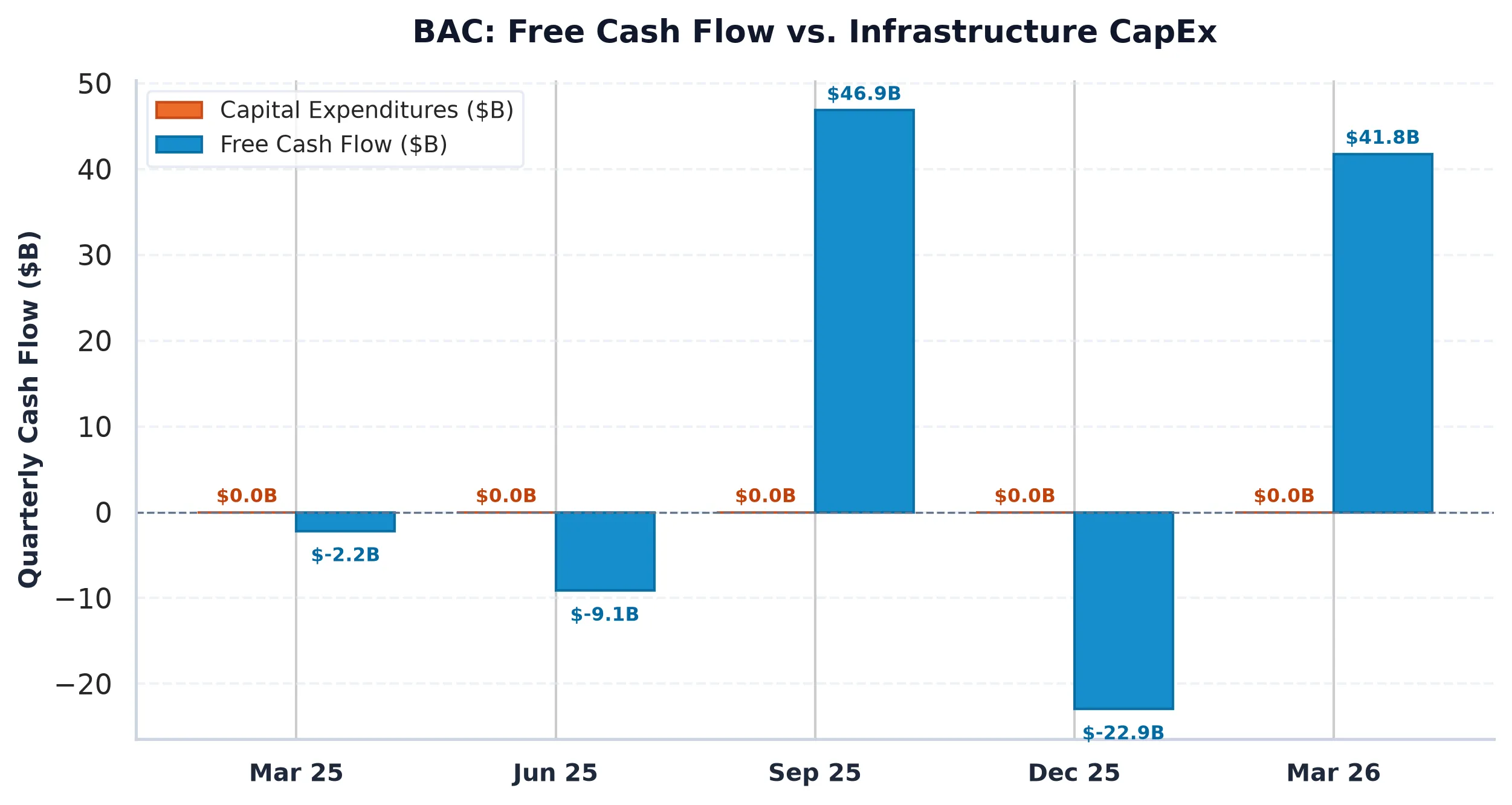
The market seems to think this is a fair trade, or at least a stable one. The bank is currently trading at a forward P/E of 9.8x, which suggests that the market expects earnings to remain resilient even as net interest margins face the pressure of a higher-for-longer rate regime. Management has been busy refreshing the board of directors, adding two new members to oversee the sprawling operation. This move, combined with the recent $1.21 billion compliance settlement, suggests an institution in the middle of a regulatory house-cleaning.
From a market structure perspective, the plumbing is currently working against any immediate breakout. Bank of America is trading at $51.14, which is uncomfortably close to the Max Pain strike of $51.00. In the world of options dealers, this creates a magnetic pull. With a Put/Call open interest ratio of 0.56, the crowd is decidedly leaning toward the bullish side. There is a massive Call Wall at $52.00, representing over 16,000 contracts that act as a ceiling. If the stock tries to rally, dealers who sold those calls will likely have to sell the underlying stock to hedge their positions, effectively capping the upside.
The 30-day expected move is roughly 8.5%, or about $4.35 in either direction. This implies that while the long-term story is one of stable, if uninspired, capital allocation, the short-term could see a drift toward the $49.00 Put Wall if the market decides that a 10.7% ROE is not quite enough compensation for the headache of ongoing compliance costs.
Bank of America remains a fortress, but even fortresses have expensive heating bills. With total debt at $745 billion and an operating margin of 31.26%, the bank is a finely tuned machine that requires a specific interest rate environment to truly hum. For now, it is a game of inches, where the bank tries to grow its 7.10% revenue faster than the regulators can write tickets.
Bank of America Corporation (BAC)
Trailing P/E
Marcus Wolfe Screen
Leverage Profile
30D Channel
Banking liquidity & regulatory capital compliant (Basel III / CET1 governed); deposit & trading settlement flows normalized.
Tier 1 Regulatory Capital & Liquidity Coverage Ratio (LCR) compliant; balance sheet governed by Basel III capital buffers.
Evaluated against 5.10% US 10-Yr Benchmark; bank net interest margins sensitive to yield curve slope (2s10s spread) and deposit beta.
Max Pain: $51.00 (-0.27%) | P/C Ratio: 0.56 | 30D Channel: $47.47 – $54.81.
$47.05 – $49.09 (-4% to -8% Pullback Accumulation)
Sustained weekly close below $46.03 (-10.0% structural stop) or fundamental cash flow deterioration.